

Examination Under Oath (EUO): What to Expect in Insurance Claims
Imagine receiving a certified letter days after a house fire. The insurance company wants you to appear for an Examination Under Oath (EUO). Your stomach drops. Is this an interrogation? Do you need a lawyer? Can you say no?
If you’re facing an insurance claim investigation, an EUO request can feel overwhelming. You’re dealing with loss, stress, and now, formal legal procedures. This guide explains exactly what to expect during an Insurance Claim EUO, your rights under state laws, and how to protect your claim. Understanding the EUO process helps you approach the session prepared rather than frightened. We’ll walk through the statutory basis for these examinations, the specific documents insurers can demand, and the critical differences between an EUO and a deposition. You’ll learn why refusing an EUO can jeopardize your claim, and when consulting with an Examination Under Oath lawyer becomes essential.
What Is an Examination Under Oath (EUO)?
An Examination Under Oath is a sworn, recorded question-and-answer session that your insurance policy likely requires you to attend after a major loss. According to the International Risk Management Institute (IRMI), an EUO is taken under the authority of a policy condition, usually statutorily imposed as part of the standard fire policy. This isn’t a casual chat with your adjuster. It is a formal proceeding where you testify under oath about the details of your claim.
If you’re wondering, “What is an EUO in practical terms?” think of it as the insurer’s tool to obtain information necessary to process your claim. The session appears in your policy conditions alongside requirements like submitting a proof of loss. For example, under New York Insurance Law § 3404, the standard fire policy requires the insured to submit to examinations under oath by any person named by the insurer and to sign the testimony. Similarly, Minnesota Statutes § 65A.01 establishes that submitting to an EUO is a contractual duty after loss.
Is an EUO required by your insurance policy? Generally, yes. Standard policies, particularly those governed by state statutory forms like the New York and Minnesota examples cited above, include this as a mandatory condition. Refusal to participate can constitute a breach of your policy obligations. The examination enables the insurer to verify your sworn statement against the books of account, bills, and invoices you must also produce. It serves an investigative purpose distinct from preliminary interviews, allowing the carrier to probe the scope of damage and the validity of claimed losses under oath.
Unlike informal conversations about your deductible or temporary housing, an EUO demands precision. You’re obligated to produce books of account, bills, invoices, and other vouchers at a reasonable time and place, as specified in New York’s statutory language. These documents form the foundation of your sworn proof of loss, which standard policies typically require within 60 days unless the insurer provides a written extension. The EUO allows the carrier to question these materials thoroughly, verifying the loss details align with your financial records and the scope of damage you’ve reported.
Why Your Insurance Company Requests an EUO
Insurers don’t request an EUO arbitrarily. Under typical first-party policy conditions—often labeled “duties after loss”—you agree to allow inspection of damaged property, produce requested records, and submit to an examination under oath. The American Bar Association (ABA) notes that these conditions make submission to an EUO a prerequisite to recovering for covered loss or damage.
Do you have to attend an EUO if your insurer requests it? In most cases, yes. The policy language treats this as a condition precedent to payment. When you ask, “Is an EUO required by my insurance policy?” the answer lies in your specific declarations page and conditions section, though standard forms heavily favor mandatory compliance. Your carrier usually requests this examination when they need to verify loss details, clarify discrepancies in documentation, or understand the full scope of damage. An experienced attorney can review the EUO request to ensure it complies with state law and your policy terms. For policyholders in Texas, for example, working with a firm that handles civil litigation and insurance disputes, such as the Omar Ochoa Law Firm, can provide this necessary oversight.
The request typically arrives when the adjuster encounters complexities in your claim—perhaps involving large financial losses, prior claims history, or questions about the cause of damage. While the process feels adversarial, insurers view it as a standard audit mechanism to confirm that the claim falls within the policy’s coverage grants and that you’ve satisfied your contractual duties after the loss.
What Happens During the EUO Process
Understanding the EUO process removes much of the anxiety surrounding the unknown. The procedure follows a formal structure distinct from casual claim discussions conducted over the phone or in your driveway.
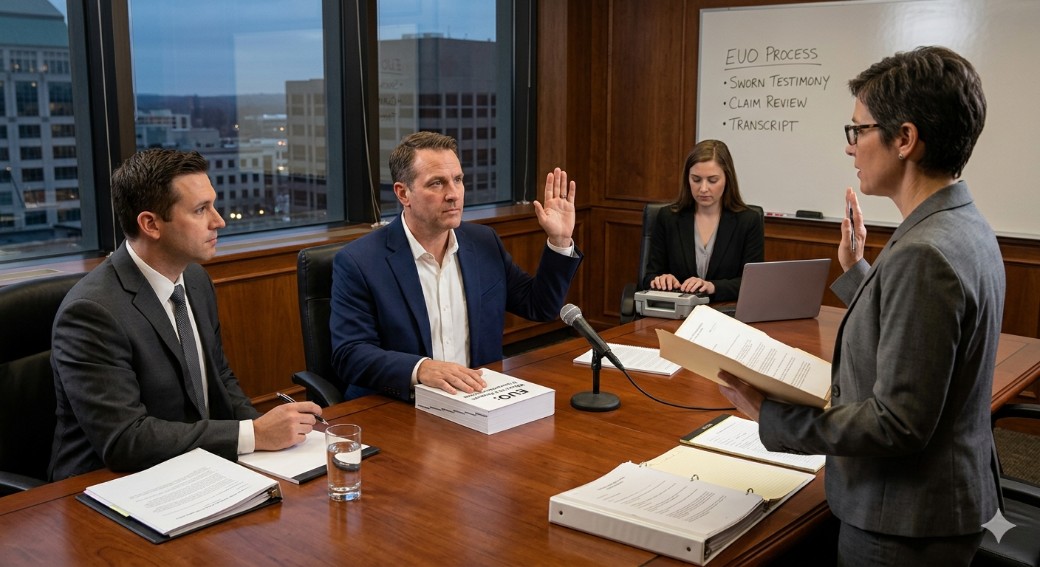
Before questions begin, a notary administers an oath, legally binding you to truthful testimony under penalty of perjury. A certified shorthand reporter sits nearby, capturing every word uttered to create a verbatim transcript that serves as the official record for the insurer’s investigation. According to IRMI, the questioning is conducted by the insurer’s adjuster or attorney in a manner similar to a deposition, though governed entirely by your policy terms rather than court rules. You can expect detailed questions regarding your personal finances, prior insurance claims, property valuations, repair estimates, and the specific circumstances surrounding the current loss. The setting is typically an office or conference room—not your home—creating a more formal atmosphere that underscores the legal seriousness of the proceeding.
The questioning may probe areas you consider personal—bank statements, previous claims from years past, or detailed inventories of damaged property. Remember that under standard policy conditions like those in New York Insurance Law § 3404, you must submit to this examination as often as reasonably required and sign your testimony when complete.
Can the EUO be recorded or transcribed? Absolutely. The session is always transcribed by the court reporter present. While policies traditionally allow for a written transcript, the right to video or audio record an EUO varies. Some states and specific policy types (like New York’s no-fault auto insurance) have explicit rules granting reciprocal recording rights, but this is not a universal standard for property claims. You must check your state’s specific insurance regulations. You might face persistent questions about your books of account, invoices, and vouchers—financial documents that form the evidentiary basis for your claimed losses and which the insurer has the contractual right to examine.
The Participants and Procedure
The cast of participants includes three key roles: the notary public who swears you in, the certified shorthand reporter who captures every statement with precision, and the questioner—either the insurance adjuster handling your file or an attorney representing the carrier. You, the insured, must review and sign the transcript of your testimony once prepared. While the adversarial questioning resembles a deposition in tone and format, it remains fundamentally a contractual process governed by your policy language and applicable state statutes rather than the Federal Rules of Civil Procedure.
Recording, Transcripts, and Your Access Rights
Once the session concludes, the reporter prepares an official transcript. Access to the transcript varies. In some specific contexts, like New York’s no-fault auto insurance system, regulations require the insurer to provide the examinee a copy. For most standard property policies, you may have to formally request a copy, and the insurer is not always obligated to provide one for free before litigation begins. Always verify your particular rights under your state’s insurance codes, as these transcription and recording protections vary substantially across different jurisdictions in the USA.
EUO vs. Deposition: Understanding the Key Differences
Many policyholders confuse an Examination Under Oath with a deposition, but these procedures serve distinct purposes and operate under different legal frameworks. Both involve sworn testimony and court reporters, yet the similarities largely end there.
An EUO is a contractual claim-process tool governed by your insurance policy and state statutes, not civil-procedure discovery rules. As the American Bar Association explains, depositions occur during active litigation as part of discovery, while EUOs occur during the claim investigation phase before any lawsuit is filed. Depositions are court-ordered and subject to rules of civil procedure, whereas EUOs derive authority from policy conditions—such as those found in the standard fire policy forms adopted by states like New York and Minnesota.
Is an EUO the same as a deposition? No. The scope differs significantly. EUOs focus specifically on matters “reasonably related to the loss” under the policy terms, including your books of account and proof of loss documentation. Depositions can cover broader ground relevant to the litigation. Additionally, EUO testimony can dramatically impact future litigation. According to the Hunton Insurance Recovery Blog, statements made during an EUO can be used against you in subsequent proceedings if the insurer denies your claim and you file suit. This dual-use potential makes accuracy imperative during the examination.
How does an EUO affect future litigation? It creates a locked-in record of your sworn statements. Any inconsistencies between your EUO testimony and later deposition or trial testimony can undermine your credibility and your case.
Your Rights and Whether You Need an Examination Under Oath Lawyer
You hold specific rights when facing an EUO, though these protections vary by jurisdiction. Understanding them helps you navigate the examination strategically.
Do you have the right to a lawyer at an EUO? Generally, yes, though the scope of counsel’s role differs from courtroom representation. Minnesota Statutes § 65A.01 explicitly requires that the insured be informed of the right to counsel before the EUO and that answers may be used in later civil or criminal proceedings. This statutory warning provides crucial context about the stakes involved. However, as noted by the Minnesota Lawyers Professional Responsibility Board, while counsel may be present, they typically cannot cross-examine you or object to questions in the same manner as during a deposition or trial.
Can you reschedule an EUO or request a different location? Yes, within reason. Standard policy language requires the examination occur at a “reasonable time and place.” Under New York Insurance Law § 3404 and Minnesota Statutes § 65A.01, you must produce documents and appear at a reasonable time and place, which implies mutual accommodation for scheduling conflicts or geographic convenience. You may possess the right to record the examination yourself in certain jurisdictions, though this is not guaranteed. It’s crucial to consult local law, as rules for a property claim EUO may differ significantly from those for other claim types, such as auto insurance.
While not every state mandates legal representation during an EUO, consulting an Examination Under Oath lawyer is often advisable. Counsel can help you organize documents, understand the boundaries of reasonable questions, and ensure you don’t waive rights inadvertently. When facing a complex insurance claim investigation, having professional guidance prevents costly missteps. For a detailed walkthrough of how to prepare, this comprehensive Insurance EUO guide offers valuable insights.
State-Specific Rights and Protections
Rights vary significantly across state lines. Minnesota requires explicit warnings about future use of testimony and the right to counsel. State-specific protections exist but are often narrow. For example, in the highly regulated field of New York no-fault auto insurance, insurers cannot compel an examinee to use “props” during testimony. Similarly, specific rules may govern who a corporate entity must produce for an EUO. These examples highlight that unique protections may exist in your state, but they are rarely universal. These nuances underscore why understanding your specific state’s statutory framework matters enormously.
Preparing for Your EUO: Documents and Logistics
Preparation determines success in this formal setting. Standard policies require you to produce specific documentation, and organizing these materials in advance demonstrates good faith while protecting your legal interests.
What documents can the insurer demand for an EUO? Under standard fire policy provisions like those codified in New York Insurance Law § 3404 and Minnesota Statutes § 65A.01, you must provide books of account, bills, invoices, vouchers, or certified copies reasonably related to the loss. You must also allow the insurer to copy or extract information from these records at a reasonable time and place. This statutory language implies mutual accommodation—you can request scheduling changes or different locations that don’t unduly burden the insurer’s investigation.
Can you reschedule an EUO or ask for a different location? Yes, provided you maintain reasonableness and comply with statutory timeframes. If the proposed date conflicts with medical appointments or work obligations, propose alternatives promptly. Minnesota law requires the examination occur within a reasonable period after the insurer’s demand, while New York’s standard policy requires cooperation at reasonable times.
Practical preparation involves gathering bank statements, receipts, inventory lists, prior claims history, and your sworn proof of loss documentation. Create duplicates of everything you provide to the examiner. Review your previous insurance applications for any discrepancies that might raise questions. If your policy requires a proof of loss within 60 days unless extended in writing by the insurer, ensure this is filed before the EUO to avoid procedural challenges that could delay payment.
Organizing Financial Records and Proof of Loss
Compile your books of account, invoices, and vouchers as required by standard fire policies. These materials must support the figures in your sworn proof of loss statement. Under many standard policies, a signed and sworn proof of loss must be submitted. The deadline for this is critical; often, it is 60 days from when the insurer requests it and provides the necessary forms, though this can vary. Failure to meet this deadline can jeopardize your claim. Organize these documents chronologically and by category to facilitate smooth questioning and demonstrate the legitimacy of your claimed damages.
Common Mistakes and Pitfalls to Avoid During an EUO
What you don’t do during an examination often matters as much as what you do. Common errors can jeopardize otherwise valid claims.
Volunteering information beyond the specific question asked represents the most frequent mistake. Answer truthfully, but concisely. Don’t speculate or guess—if you don’t know an answer, state “I don’t know” rather than approximating. Guessing creates inconsistencies that the insurer can use to challenge your credibility.
Failing to review documents beforehand creates another trap. If you testify about invoice amounts or dates from memory while holding documents that contradict your testimony, you create problems. Always review your books of account, bills, and vouchers before the session.
Being confrontational or uncooperative rarely helps. While the process feels adversarial, hostility can suggest you’re hiding something. Conversely, understanding the scope of document requests protects you from overreach. Refusal to cooperate with reasonable requests—without legal justification—can lead to claim denial per policy conditions.
However, insurers cannot demand unreasonable “props” or specific corporate representatives in certain contexts. Knowing the specific limits in your state and under your policy is key. While an insurer’s questions must be reasonable and material to the loss, what constitutes an “improper demand” is a complex legal question. This is an area where an experienced attorney can provide critical guidance to distinguish between legitimate inquiries and insurer overreach.
Refusing an EUO: Consequences and Claim Denial Risks
The decision to refuse an EUO carries severe consequences. Under most standard policies, submitting to an examination constitutes a condition precedent to recovering for any covered loss or damage. The American Bar Association confirms that refusal can result in claim denial based on breach of policy conditions.
Can the insurer deny my claim if I refuse an EUO? Yes. If you fail to appear, fail to answer questions, or refuse to provide the required books and records without justification, the carrier may legally deny coverage. This isn’t merely a threat—courts generally enforce these policy provisions strictly.
Do you have to attend an EUO if your insurer requests it? You must comply unless the request is unreasonable in time, place, or scope. Both New York Insurance Law § 3404 and Minnesota Statutes § 65A.01 incorporate reasonableness standards regarding when and where examinations occur. If the insurer demands appearance within hours of notice or at a location hundreds of miles from your home without accommodation, you may have grounds to object. However, simply disagreeing with the insurer’s investigation does not justify refusal.
Some states impose specific time limits. Minnesota requires the examination occur within a reasonable period after the insurer’s demand, preventing indefinite delay tactics by carriers. Understanding these statutory boundaries helps you recognize when a refusal is legally justified versus when it will merely trigger a denial of your Insurance Claim EUO obligations.
What Happens After the EUO Is Completed
Once you leave the examination room, the formal process continues behind the scenes. The certified shorthand reporter prepares the transcript and delivers it to the insurer, who then completes its investigation before rendering a claim decision. You should follow up with the adjuster regarding any additional documentation requests, but avoid pressing for immediate timelines—decision schedules vary by state complexity and claim type.
Will you get a copy of the EUO transcript or recording? It depends on your jurisdiction and policy type. Under NY DFS OGC Opinion No. 04-08-31, New York no-fault regulations require insurers to provide the examinee a copy of the recording or transcript with an affirmation that it is unredacted. Standard property policies in other states may not automatically provide copies unless specifically requested or required by state regulation.
How does an EUO affect future litigation? Your sworn testimony creates a permanent record. If the insurer denies your claim and you file suit, they can use this transcript to impeach your credibility if your later testimony contradicts your EUO statements. As noted by the Hunton Insurance Recovery Blog, these examinations often serve as the foundation for the insurer’s litigation strategy. Resources like GED Lawyers EUO FAQs suggest remaining patient during the post-examination phase while maintaining organized records of any subsequent communications with the carrier.
Conclusion
Navigating an Examination Under Oath requires understanding your contractual duties, statutory rights, and the procedural landscape of insurance claims. Remember three key takeaways: First, the EUO is a mandatory condition under most standard policies, not an optional interview. Second, preparation—organizing your documents and reviewing your history—protects you from inadvertent errors. Third, while you have rights regarding counsel and scheduling, refusal to participate reasonably can result in claim denial.
Approaching this process armed with knowledge transforms anxiety into confidence. You now understand what happens during the EUO process, how it differs from a deposition, and what documents you must prepare. If you face complex issues or unreasonable demands, consult qualified legal counsel who understands your state’s specific statutory framework. Your claim deserves careful attention, and your rights deserve vigilant protection.