

Retail Store Injury: Essential Legal Steps and Evidence Guide
You’re browsing the aisles when suddenly your feet slip out from under you. A spilled liquid, a frayed mat, or a fallen box changes everything in seconds. If you’ve suffered a retail store injury, you’re not alone—thousands of customers face similar accidents annually. The actions you take during the next hour can determine whether you recover fair compensation or struggle to prove your claim. This guide walks you through the critical legal steps, evidence preservation tactics, and compensation strategies you need to protect your rights after an accident on commercial property.
Understanding Retail Store Injuries and Premises Liability
Premises liability is the legal theory that holds property owners responsible for unsafe conditions that injure lawful visitors. Under this framework, retail stores owe customers a duty of care to maintain reasonably safe premises. This isn’t just a courtesy—it’s a legal obligation that requires regular inspections, prompt repairs of hazardous conditions, and adequate warnings when dangers exist. According to Justia Legal Guides, this duty extends to maintaining safe walkways, securing merchandise properly, and addressing known hazards within a reasonable timeframe.
Common retail hazards that trigger these claims include slippery floors from spills or recently mopped surfaces, trip hazards like uneven flooring or cluttered aisles, falling merchandise from improperly stacked shelves, and defective store fixtures such as broken handrails or malfunctioning automatic doors. Each of these scenarios represents a potential breach of the store’s duty to keep you safe while shopping. The duty of care requires stores to conduct reasonable inspections of their property, promptly address dangerous conditions once discovered, and provide adequate warnings when hazards cannot be immediately remedied. For example, if a customer spills a drink in an aisle, the store has a duty to discover that hazard within a reasonable time and either clean it immediately or place warning cones around it until staff can remediate the danger.
These legal principles apply generally across the USA, though specific procedural requirements vary significantly by jurisdiction. Some states follow pure comparative negligence rules, while others bar recovery if you’re found even slightly at fault. Understanding premises liability helps you recognize when a store has failed its legal obligation to protect customers from foreseeable harm. The specific procedures for filing claims and the standards for proving negligence will depend on whether your incident occurred in a comparative fault state or a jurisdiction following contributory negligence principles.
Immediate Actions: What to Do After a Retail Injury
The first hour after a retail injury is critical for your health and your legal claim. Start by seeking immediate medical attention, even if you feel fine—adrenaline often masks serious injuries like concussions, internal bleeding, or spinal damage that may not manifest symptoms until hours or days later. According to Jason Kisner Law, getting medical records from your initial treatment will serve as crucial proof of injury and causation in your eventual claim. Delaying medical care not only jeopardizes your health but also gives insurance adjusters ammunition to claim your injuries occurred elsewhere or are less severe than alleged.
Next, report the incident to store management immediately. Locate the manager on duty and insist they create an official accident report. Ask for a copy of this report before leaving the premises, or at minimum, record the name and title of the employee completing it along with the date and time. According to Justia, immediate reporting creates a contemporaneous record of the incident that prevents the store from later claiming the event never occurred. When reporting, stick to the basic facts—what happened, where, and when—without speculating about fault or making offhand comments that could be construed as admissions.
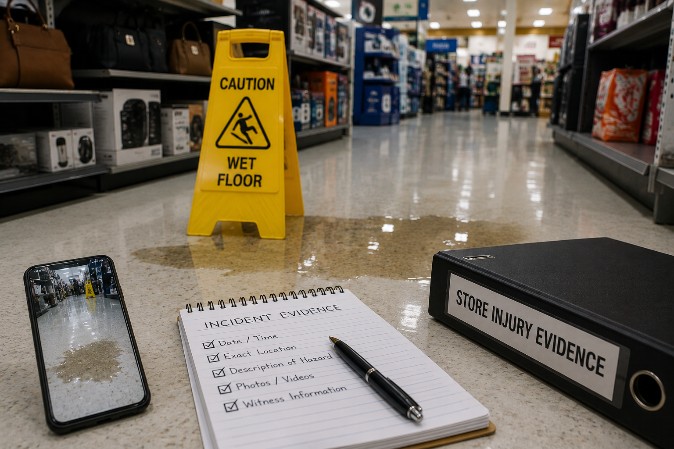
Document everything while you’re still at the scene. Use your phone to photograph the hazard that caused your fall from multiple angles, the surrounding area to establish context, and any visible injuries on your body before they begin to swell or bruise. Collect contact information from any eyewitnesses, including names, phone numbers, and email addresses—their statements can corroborate your account later when memories fade. Write down exactly what happened while the memory is fresh, noting the time, date, weather conditions, and what you were doing immediately before the incident. For comprehensive guidance on these immediate steps, see these Store slip and fall steps specific to Crestview, though the principles apply nationwide.
Preserve your shoes and clothing exactly as they were during the accident. Do not wash them. These items may contain residue from the floor or damage patterns that prove the nature of the hazard. Store them in a sealed bag in a safe location where they won’t be disturbed until your attorney can examine them.
Evidence Preservation Strategies for Store Injury Claims
Evidence preservation determines the strength of your premises liability claim. Without proper documentation, memories fade, hazards get repaired, and stores may claim the dangerous condition never existed. According to Zayas Law, witness statements, medical records, and clear photographs establish what happened, who bears responsibility, and the extent of your damages. Without this evidence, your claim becomes a “he said, she said” battle that benefits the corporate defendant.
Act immediately to document injuries and hazard conditions. Photograph bruises, cuts, and swelling before they heal. Measure the hazard if possible—a half-inch height difference matters legally and can distinguish between a trivial defect and a dangerous condition. The lack of evidence weakens claims significantly because undocumented details become harder to prove as time passes, and stores may argue your injuries occurred elsewhere or existed prior to the incident.
The Preservation Letter: Demanding Evidence Protection
A preservation letter, also called a spoliation letter, is a formal written notice demanding that the store preserve surveillance footage, incident reports, maintenance logs, and other relevant evidence before destruction or overwriting. According to DM Injury Law, send this promptly—many retailers operate on short video retention cycles, sometimes as brief as 30 days, meaning footage could disappear before you even file a claim. This letter puts the store on legal notice that evidence must be safeguarded for potential litigation and can trigger sanctions if they subsequently destroy materials.
Physical Evidence and Clothing Preservation
Keep the shoes and clothing you wore during the accident unwashed and stored in a safe place. According to Jason Kisner Law, these items may contain floor residue, tear patterns, or impact marks that demonstrate exactly how you fell. If safe and permitted, collect any physical items from the scene—a piece of broken shelving, the actual object that fell, or remnants of the slippery substance. These tangible items often provide irrefutable proof of the hazard’s existence that contradicts the store’s potential denials.
Securing Surveillance Footage and Digital Evidence
Digital evidence often makes or breaks retail injury claims. Request that store management preserve security camera footage immediately. While stores may decline to provide you with copies immediately—citing corporate policy or pending investigation—securing their commitment to preservation is essential. Law Offices of Jay S. Knispel advises asking the store manager to complete an accident/incident report and preserve security camera footage specifically.
If the store claims footage was already deleted, they may face serious legal consequences for the destruction of evidence, known as spoliation. Most states have rules that allow courts to sanction parties who fail to preserve relevant evidence once litigation is anticipated. If a court finds a store intentionally destroyed footage to hide its negligence, it may impose harsh penalties, such as instructing the jury to assume the lost video would have proven the store’s fault, ordering the store to pay fines, or in some cases, entering a judgment automatically in the victim’s favor.
Incident Reports and Maintenance Logs
Incident reports and maintenance/cleaning logs are critical evidence to establish notice of hazards and standard operating procedures. According to preservation standards outlined by DM Injury Law, these documents include incident reports and maintenance logs. When reviewing these documents, record the manager’s full name, the exact date and time of the report, and any admissions regarding prior knowledge of the dangerous condition. These logs often reveal patterns of negligent maintenance or repeated safety violations that strengthen your claim by proving the store had notice of recurring problems.
Legal Consequences for Destroyed Evidence (Spoliation)
The legal doctrine of spoliation holds parties accountable for destroying evidence relevant to a lawsuit. Once a store is on notice of a potential claim (for example, after you file an incident report or send a preservation letter), it has a legal duty to preserve relevant evidence like surveillance footage. Each state has its own rules for handling spoliation. If a store fails in this duty, your attorney can file a motion asking the court to sanction the store. These sanctions are designed to punish the bad behavior and prevent the store from benefiting from its own destruction of proof.
Proving Negligence in a Retail Store Injury Claim
Proving negligence requires evidence that the store breached its duty of care. According to Davidoff Law, you should collect medical records, an incident report, surveillance footage, and witness statements. This combination establishes the hazard existed, the store knew or should have known about it, and the hazard directly caused your injuries. You must demonstrate that the store failed to act as a reasonably prudent retailer would under similar circumstances, either by creating the hazard, failing to inspect for it, or delaying remediation after discovery.
Falling merchandise presents distinct challenges from slip and fall accidents. While both fall under premises liability, falling merchandise injuries typically involve improper stacking, overloaded shelves, or lack of warning signs about heavy items overhead. Liability may extend to the store, third-party vendors who stocked the shelves, or even product manufacturers if shelving units were defective. Gathering the same core evidence—medical documentation, incident reports, and witness statements—proves essential in these cases, though the hazard patterns differ significantly from transient spills or obstacles.
Falling Merchandise vs. Slip and Fall Accidents
While slip and fall accidents involve transient conditions like wet floors or obstacles in walkways, falling merchandise injuries stem from structural or procedural failures in inventory management. Davidoff Law notes that both claims require proving the same legal element: that the store knew or should have known of the dangerous condition and failed to remedy it within a reasonable time. Whether you’re struck by a falling box or slip on a wet surface, the evidence needed to establish liability remains consistent—documentation of the hazard, proof of notice, and clear medical causation. Justia lists common retail hazards including falling merchandise and slip/trip hazards that create liability.
Calculating Store Injury Compensation and Damages
Medical records serve as the foundation for proving both injury severity and causation. Without timely medical documentation connecting your injuries directly to the store incident, the defense will argue your damages stem from pre-existing conditions or subsequent events. Damages in premises liability claims typically include economic damages like medical expenses and lost wages, as well as non-economic damages for pain and suffering, emotional distress, and loss of enjoyment of life. Future rehabilitation costs and diminished earning capacity also factor into comprehensive valuations.
Clients frequently ask, “How much is my retail injury case worth?” The answer depends on injury severity, evidence strength, and the jurisdiction’s damage caps or negligence standards. Another common question: “Should I accept the store’s offer to pay my medical bills?” Generally, avoid accepting initial offers without legal counsel. Early offers rarely account for future medical needs, lost earning capacity, or non-economic damages, and often require signing broad releases that bar future claims. According to Jason Kisner Law, medical records serve as proof of injury and causation that justify higher valuations. Compensation varies widely based on whether you can prove the store’s negligence clearly and the extent of your documented injuries. Strong evidence preservation directly correlates with higher settlement values, as clear documentation leaves little room for defense arguments disputing liability or damages.
When to Consult a Premises Liability Lawyer
Timing matters when seeking legal counsel. Consult a premises liability lawyer before giving recorded statements to insurance adjusters or signing any documents—these statements can be used against you later and often lock you into versions of events before you understand the full extent of your injuries. Justia warns that what not to do includes giving recorded statements without advice or signing blanket medical authorizations that allow insurers to dig through your entire medical history unrelated to the accident.
Bring specific evidence to your personal injury attorney consultation: photographs of the scene and injuries, a complete witness list with contact information, all medical records and bills, the incident report, and your preserved clothing and shoes. This documentation allows the attorney to evaluate liability and damages accurately during your initial meeting.
Choose specialists over generalists when possible. While any personal injury attorney can handle basic claims, premises liability specialists understand the nuances of notice requirements, retention policies for surveillance footage, and specific defenses retailers commonly raise. Firms like Michles & Booth focus specifically on accident and injury cases, bringing targeted expertise to complex retail liability matters. Their focused approach often proves invaluable when facing corporate defendants with aggressive defense strategies. An experienced attorney can also draft effective preservation letters and navigate the complexities of proving negligence in retail environments.
FAQ: Statutes, Fault, and Evidence Timelines
How long do I have to file a slip and fall lawsuit? Statutes of limitations vary by state, ranging from one to six years for premises liability claims. However, acting quickly to preserve evidence is universally critical regardless of your state’s filing deadline. Waiting too long risks destruction of surveillance footage and fading witness memories.
Can I still recover damages if I was partially at fault? Most states follow comparative negligence rules, allowing recovery reduced by your percentage of fault. Some jurisdictions bar recovery entirely if you’re more than 50% at fault, while others use contributory negligence rules that bar recovery for any fault. Local law determines your specific rights. Understanding premises liability helps clarify that even partial responsibility doesn’t necessarily end your claim in most jurisdictions.
What is adverse inference spoliation? This is a legal instruction a judge can give to a jury. It allows the jury to assume that evidence a party improperly destroyed or lost would have been unfavorable to that party. For example, if a store destroyed surveillance video of your fall, the judge might instruct the jury to assume the video would have shown the store was negligent. This powerful tool helps level the playing field when crucial evidence goes missing.
Does the store have to tell me if they have cameras where I fell? Stores generally have no affirmative duty to disclose camera locations immediately, though they must preserve footage once litigation is reasonably anticipated. Your attorney can discover this information through formal legal processes during the claim. Documenting store accident details independently remains essential regardless of camera disclosure.
Can I sue if the store had a ‘wet floor’ sign up? Possibly. A warning sign does not automatically absolve a store of liability. Your attorney will analyze if the sign was placed in a visible, effective location and whether the hazard existed for an unreasonable amount of time. The presence of a sign is just one factor in determining whether the store acted reasonably.
Conclusion
Protecting your rights after a retail store injury requires immediate action, meticulous evidence preservation, and strategic legal guidance. Remember these three essentials: document everything immediately while memories are fresh, preserve all physical and digital evidence including clothing and shoes, and consult a specialized premises liability attorney before speaking with insurance representatives. The steps you take in the hours following an accident significantly impact your ability to recover fair compensation for medical bills, lost wages, and pain and suffering. Don’t navigate this complex process alone—secure your evidence, understand your rights under premises liability law, and take action today to protect your future.