

Proving Employer Retaliation Under California Labor Laws and EEOC Guidelines
Imagine you reported safety violations, and suddenly your shifts vanished. Or you requested a disability accommodation, and now you’re written up for minor infractions others ignore. This is employer retaliation California workers face daily. Understanding your rights under state and federal law is the first step toward protecting your livelihood. This guide breaks down exactly what qualifies as illegal retaliation, how to prove it, and where to file your claim. Whether you’re dealing with a demotion, termination, or subtle punishment, knowing the legal framework helps you take informed action before critical deadlines expire.
What Is Employer Retaliation Under California Law?
Under California’s Fair Employment and Housing Act (FEHA), specifically Government Code Section 12940(h), retaliation occurs when employers punish workers for engaging in legally protected activity. The California Civil Rights Department (CRD)—formerly DFEH—explains that retaliation claims require three elements: protected activity, adverse action, and causation. These California workplace retaliation laws cover employers with five or more employees.
Retaliation includes any action materially changing employment terms for the worse after asserting rights. However, not every unfair action is illegal. Difficult managers or favoritism may be unfortunate but lawful. The key is motivation: if your employer demotes you specifically because you filed a discrimination complaint, that crosses the line. If they demote you for documented performance issues pre-dating your complaint, that’s likely lawful.
California recognizes two main claim categories. FEHA-based claims, handled by the CRD, cover retaliation for opposing discrimination, harassment, or requesting accommodations. Labor Code-based claims, handled by the Department of Industrial Relations (DLSE), cover whistleblower protections and retaliation for wage or safety complaints. Understanding which framework applies determines where you file and what you must prove. Both systems protect workers but feature different procedures, deadlines, and remedies. Recognizing the difference between general unfair treatment and illegal employer retaliation California laws prohibit ensures you pursue the correct legal pathway.
Protected Activities and Adverse Actions Under State and Federal Guidelines
Protected activity forms the foundation of any retaliation claim. Under FEHA, this includes opposing discrimination or harassment, filing a complaint with the CRD, participating in investigations, or requesting reasonable accommodations. You don’t need legal training to trigger these protections. According to the CRD, you simply need to make clear that you believe your employer may have broken the law—you don’t need to cite specific statutes. Even encouraging a coworker to file a complaint counts as protected activity.
The Labor Code offers additional protections through Section 1102.5, shielding employees who disclose violations to government agencies or internal supervisors. This statute also protects you if you refuse to participate in illegal acts or if you’re believed to have disclosed violations. Post-employment retaliation is prohibited, meaning former employers cannot blacklist you or give false references because you blew the whistle.
Adverse actions extend far beyond termination. The DLSE’s guidance on retaliation complaints lists discharge, demotion, suspension, reduced pay or hours, refusal to hire or promote, and immigration-related threats as qualifying actions. If your employer threatens to report you to immigration authorities after you complain about wage theft, that constitutes retaliation.
Federal standards under the EEOC define retaliation using a “materially adverse” standard. This covers any action that might deter a reasonable person from engaging in protected activity, including actions outside the workplace like giving false references. While the CRD and DLSE have their own definitions, the EEOC retaliation guidelines illustrate how retaliation manifests in subtle ways. Understanding these employee rights retaliation California and federal agencies enforce helps you identify when your employer crosses the line from unpleasant management into illegal conduct.
How to Prove Retaliation at Work in California: The Three Essential Elements
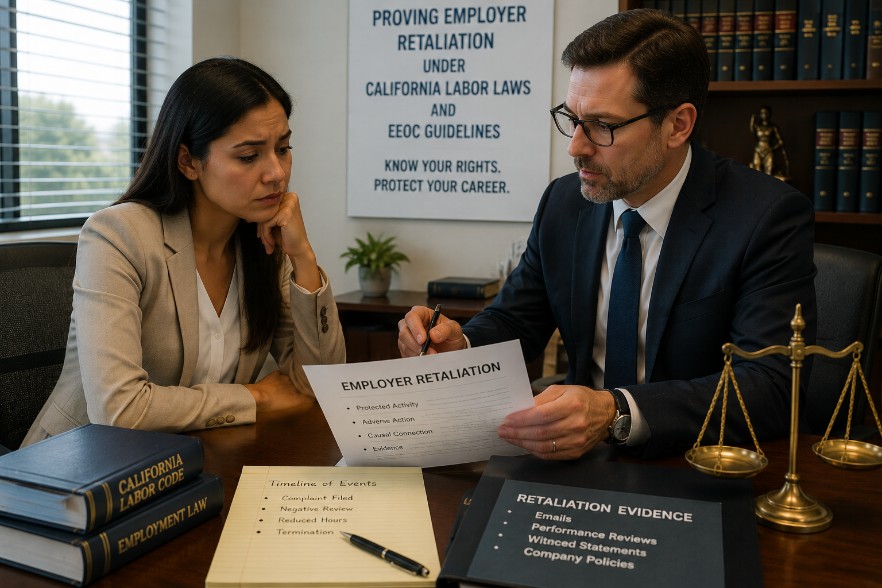
Proving retaliation requires documenting three essential elements. First, show you engaged in protected activity—emails showing you requested an accommodation or reported harassment. Second, demonstrate your employer took an adverse action against you—pay stubs showing reduced hours or disciplinary notices dated after your complaint. Third, establish causation, showing the adverse action happened at least in part because of your protected activity.
Timing provides strong evidence of causation. When demotion occurs days after your complaint, courts infer a causal link. However, you can prove retaliation even with delayed action if you show escalating hostility or statements linking punishment to your complaint. The CRD fact sheet emphasizes you need not prove retaliation was the only reason, just a contributing factor.
California and federal agencies differ on causation standards. Under FEHA, California courts often use a motivating factor test. For whistleblower claims under Labor Code Section 1102.5, the burden-shifting framework creates a specific pathway. Understanding how to prove retaliation at work California courts recognize involves gathering direct evidence (emails mentioning your complaint) and circumstantial evidence (sudden pattern changes). You don’t need legal terminology when complaining—stating “I think this is discrimination because of my pregnancy” is sufficient without citing specific statutes.
Understanding the Burden-Shifting Framework Under Labor Code § 1102.6
Under Labor Code § 1102.6, once you show your protected whistleblowing was a contributing factor by a preponderance of the evidence, the burden shifts to your employer. They must then prove by clear and convincing evidence that the action would have occurred anyway for legitimate, non-retaliatory reasons. This higher standard makes it harder for employers to justify their actions after retaliation is established, giving California workers stronger protections than federal standards in many whistleblower cases.
Causation Standards: California Contributing Factor vs. EEOC But-For
California’s whistleblower framework uses a “contributing factor” test under § 1102.6, meaning retaliation need only be one of several motivations. In contrast, the EEOC applies a “but-for” standard to federal Title VII claims, requiring proof that the retaliation would not have happened absent the protected activity. While seemingly stricter, the EEOC standard still allows for mixed-motive analysis in certain contexts. Understanding this distinction affects which evidence you gather and which legal strategy applies to your specific claim.
California Whistleblower Protection and Third-Party Retaliation Rules
Labor Code § 1102.5 provides strong California whistleblower protection. You’re shielded whether reporting violations to government agencies or internal supervisors. The law protects you if you have reasonable cause to believe your employer violated law, regardless of whether an actual violation occurred. You’re also protected if you refuse to participate in activities violating laws or regulations, meaning you cannot be punished for saying no to illegal directives like falsifying safety records.
The statute extends beyond current employment. Under subsection (d), post-employment retaliation is prohibited, preventing former employers from blacklisting you or giving false negative references. Subsection (h) protects family members—if your employer retaliates against your spouse, parent, or child because of your whistleblowing, that action is independently unlawful.
Violations carry serious consequences. Employers face civil penalties up to $10,000 per employee per violation under § 1102.5(f), awarded directly to the retaliated employee. The Labor Commissioner considers severity and employer history when assessing penalties.
These protections differ from FEHA retaliation. While FEHA requires filing with the CRD and covers discrimination-based retaliation, Labor Code claims typically go through the DLSE and focus on whistleblowing and labor violations. The CRD handles civil rights matters, while the DLSE manages wage, hour, and whistleblower retaliation. These pathways operate independently, meaning you might have claims under both statutes if you reported discrimination to HR and faced termination. Understanding which applies ensures correct filing.
Where to File: Navigating CRD, DLSE, and EEOC Retaliation Claim Pathways
Choosing the correct agency prevents costly delays. For FEHA-based retaliation—discrimination, harassment, or accommodation requests—file with the California Civil Rights Department. You have three years from the adverse action to file, but you cannot proceed to civil court without first obtaining a right-to-sue notice from the CRD. This administrative exhaustion is mandatory, though you can request the notice immediately if you prefer litigation.
For Labor Code violations—whistleblowing, wage complaints, or safety reports—the DLSE handles your claim. Deadlines are complicated: the DLSE procedure page indicates one year, while older guidance references six months. Verify current deadlines directly with the DLSE before filing, as missing them permanently bars your claim.
The DLSE filing page confirms that you do not need to be a U.S. citizen or provide a Social Security number or photo ID, and your immigration status will not be questioned. For federal claims under Title VII or the ADA, file with the EEOC, which coordinates with state agencies. When facing complex retaliation, consulting with HBK Lawyers APC can help you navigate these administrative requirements and choose the most strategic filing path.
CRD vs. DLSE: Jurisdiction and Deadline Conflicts
The CRD handles discrimination and retaliation under FEHA with a three-year filing window and requires a right-to-sue notice before civil court litigation. The DLSE manages Labor Code violations including whistleblower and wage retaliation, but conflicting guidance exists regarding deadlines—some sources indicate one year while others suggest six months. Always verify current deadlines with the DLSE directly before filing. Missing these administrative deadlines can permanently bar your claim, regardless of how strong your evidence might be or how egregious the employer’s conduct appears to be.
Federal EEOC Coordination and Materially Adverse Standards
When filing with the EEOC for federal retaliation claims, the agency coordinates with California’s CRD through work-sharing agreements to avoid duplicate investigations. The EEOC’s “materially adverse” standard captures actions outside the workplace that might deter protected activity, such as filing false criminal charges or giving negative references to prospective employers. While California’s statutes have their own definitions of adverse action, the EEOC’s broad interpretation often overlaps with state protections, meaning the same conduct might violate both federal and state standards simultaneously, giving you multiple avenues for relief.
Documenting Evidence for Workplace Retaliation and Immigration-Related Threats
Strong evidence transforms weak claims into winning cases. Create a detailed timeline documenting every protected activity and subsequent adverse action. Save all emails, texts, and memos mentioning your complaint or punishment. Screenshot scheduling apps if hours suddenly decrease, and keep performance reviews from before and after your protected activity to show changed treatment. Witness statements from coworkers who observed retaliation or heard threatening comments prove invaluable.
Immigration-related threats constitute serious adverse actions under DLSE guidance. If your employer threatens to report you to ICE after you complain about wage theft, document these threats immediately. The DLSE filing page explicitly states that immigration status is irrelevant to your right to file a retaliation complaint, and such threats often strengthen your case by showing the employer’s animus.
Remember, you don’t need legal terminology to trigger protections. According to the CRD, simply making clear that you believe the employer broke the law is sufficient. The EEOC notes that off-site actions like filing false police reports can be actionable retaliation.
To build your case: – Preserve all written communications mentioning your complaint – Document changes in job duties, excluded meetings, or sudden micromanagement – Record dates of threats or hostile comments by supervisors – Keep pay stubs showing reduced hours or changed pay rates – Note witnesses present during retaliatory acts
These subtle shifts often prove more damaging than single incidents, and documenting them shows a pattern of retaliatory conduct courts recognize.
Remedies and Critical Deadlines for Wrongful Termination Retaliation Cases
When retaliation costs you your job or wages, California law provides meaningful remedies. Under Labor Code § 98.6, you may be entitled to reinstatement, back pay, and reimbursement for lost wages and benefits including health insurance. These remedies aim to restore you to the economic position you would have held absent the retaliation, placing the financial burden on the employer.
Additionally, Labor Code § 1102.5(f) authorizes civil penalties up to $10,000 per employee per violation, payable directly to you rather than the state. The Labor Commissioner considers severity and employer history when determining penalties. For FEHA claims handled by the CRD, damages can include back pay, front pay, emotional distress damages, and attorney fees.
Deadlines are unforgiving. You have three years to file with the CRD for FEHA retaliation, but DLSE deadlines remain confusing—potentially six months or one year. The DLSE procedure page suggests one year, but verify immediately with current intake staff. Missing these deadlines, even by days, can permanently extinguish your right to recover regardless of evidence clarity or employer misconduct. Given the complexity of calculating limitations periods and the irreversible nature of statutory deadlines, filing promptly protects your ability to seek full compensation for wrongful termination retaliation California employees suffer.
Taking Action to Protect Your Employee Rights After Retaliation in California
If you suspect retaliation, act immediately to preserve your rights. First, document everything—create a contemporaneous timeline noting dates, witnesses, and specific supervisor comments before memories fade. Second, file with the appropriate agency: CRD for discrimination-related retaliation within three years, or DLSE for whistleblower and wage claims (verify current deadlines as they may be shorter). Third, request a right-to-sue notice from the CRD if you wish to pursue civil litigation rather than administrative resolution.
Preserve all evidence, including texts, emails, payroll records, and personnel files, as these become harder to obtain once you leave employment. Print important documents now rather than waiting. Remember that retaliation for filing a retaliation complaint is itself illegal—your employer cannot punish you for exercising these rights or cooperating with investigations.
While agencies like the CRD and DLSE provide free filing mechanisms accessible regardless of income, complex cases involving multiple claims or high-value damages often benefit from legal consultation to navigate burden-shifting standards and evidentiary requirements. Your employee rights retaliation California laws guarantee exist to protect you when you stand up against unlawful conduct, and taking prompt, organized action ensures those rights remain enforceable when you need them most.
Employer retaliation violates fundamental protections California workers depend upon to ensure safe, fair workplaces. By understanding the three essential elements—protected activity, adverse action, and causation—you can evaluate whether your experience crosses the line from unfair management into illegal conduct. Remember the critical deadlines: three years for CRD claims involving discrimination, and potentially as short as six months for DLSE matters involving wages or whistleblowing. Document everything, file promptly with the correct agency, and know that you need not face this process alone. Legal protections exist precisely because speaking up takes courage, and the law stands ready to support you when you exercise your rights.