

Correctional Facility Medical Liability: Security Protocols
Picture this: A correctional nurse enters a housing unit to conduct sick call while custody staff stand by, and an inmate suddenly presents with chest pain. The line between clinical judgment and security protocol blurs instantly. If that patient later claims inadequate care, your facility faces a lawsuit alleging constitutional violations, not mere negligence. Understanding correctional facility medical liability requires navigating a complex framework where constitutional standards meet clinical operations. This post explains the legal thresholds that trigger liability, the federal litigation pathways that shape your risk exposure, and the physical security protocols that protect both staff and patients.
The Constitutional Baseline: Deliberate Indifference vs. Medical Malpractice
Correctional healthcare liability begins with the Eighth Amendment. In Estelle v. Gamble, 429 U.S. 97 (1976), the Supreme Court established that deliberate indifference by prison personnel to an inmate’s serious medical needs constitutes cruel and unusual punishment. Unlike a typical medical malpractice claim where a doctor might miss a diagnosis through negligence, constitutional liability requires something more severe. The Court specifically distinguished “deliberate indifference” from medical malpractice in prisons, noting that a failure to perform an X-ray or use additional diagnostic techniques represents, at worst, malpractice—not a constitutional violation.
This distinction matters for institutional responsibility in correctional health. Medical malpractice involves negligence or incompetence in treatment, while an Eighth Amendment claim requires showing that officials knowingly disregarded a substantial risk. The standard tightened further in Farmer v. Brennan, 511 U.S. 825 (1994), where the Court clarified that prison officials cannot be liable unless they know of and disregard an excessive risk to inmate health or safety. It is sufficient that an official acts—or fails to act—despite knowledge of a substantial risk of serious harm.
What does this mean for your facility? A plaintiff must prove subjective knowledge. Officials must actually know the risk and disregard it. This high threshold protects against frivolous claims but demands rigorous documentation of clinical awareness. State tort claims for malpractice operate under lower negligence standards and can run parallel to federal constitutional claims, creating dual exposure for facilities. Understanding where negligence ends and deliberate indifference begins forms the foundation of your defense strategy.
Federal Litigation Pathways: §1983 Claims and PLRA Exhaustion
When inmates challenge inadequate medical care, they typically file under 42 U.S.C. §1983, which creates liability for any person acting under color of state law who deprives another of constitutional rights. This statute serves as the primary vehicle for correctional healthcare liability claims, allowing plaintiffs to seek damages and injunctive relief for Eighth Amendment violations.
However, the Prison Litigation Reform Act (PLRA), specifically 42 U.S.C. §1997e, erects a significant procedural gate. The statute requires exhaustive administrative remedies before filing any prison-conditions action under §1983 or other federal law. An inmate must complete the facility’s grievance process—filing initial complaints, appeals, and obtaining final agency decisions—before accessing federal court.
This exhaustion requirement shapes healthcare legal issues in correctional settings by forcing facilities to maintain airtight administrative records. Every denied request slip, triage decision, and notification to inmates becomes potential evidence in later litigation. For administrators, this means grievance systems are not just bureaucratic hurdles; they are liability shields. Facilities with robust documentation protocols can often defeat claims at the pleading stage by demonstrating the plaintiff failed to exhaust available remedies, or by proving the administrative record shows adequate care rather than deliberate indifference.
When facing complex civil rights litigation involving medical care failures, facilities often require specialized counsel. Firms like the Jacob D. Fuchsberg Law Firm focus on these niche areas, helping institutions navigate the intersection of constitutional standards and clinical operations.
Operational Standards for Constitutional Sick Call and Triage Systems
Constitutional adequacy requires more than avoiding deliberate indifference; it demands proactive systems. The NCCHC Standards for Health Services in Jails (or Prisons), which are the nationally recognized benchmarks for care, establishes the baseline for institutional responsibility in correctional health. These guidelines mandate a communications and sick-call system that remains accessible regardless of security classification.
What exactly is “sick call”? It is the formal mechanism allowing inmates to communicate health needs and receive clinical evaluation. According to NCCHC standards, non-emergency requests should be processed within 24 hours and scheduled for sick call within the subsequent 24-hour period. This timely access to care, generally within 24-48 hours for non-emergencies depending on the specific triage protocol, serves as a critical benchmark in risk management.
Crucially, custody staff may convey sick-call requests to medical personnel, but they may not decide which prisoners receive medical attention or determine clinical priority. Only qualified health professionals conduct triage. This separation of powers protects both clinical integrity and jail healthcare security protocols. Facilities must ensure that health-care staff—not corrections officers—control access to request systems to prevent interference that could create liability.
Request Processing and Documentation Protocols
Health-care staff must review request slips daily and notify inmates of responses, creating a contemporaneous administrative record. This documentation serves dual purposes: it demonstrates compliance with NCCHC timing benchmarks and provides evidence for PLRA exhaustion defenses. When custody controls access to request systems, opportunities for “lost” paperwork or delayed referrals multiply, increasing litigation risk. Facilities should implement sealed request boxes or electronic systems accessible only to clinical staff.
Staffing Requirements and Scheduling Benchmarks
Constitutional care requires adequate staffing. NCCHC guidelines require sick call availability at least five days per week in all but the smallest facilities, conducted by qualified health professionals in clinical settings with adequate equipment and supplies. This standard distinguishes clinical triage duties from mere custody escort functions. A nurse practitioner conducting patient assessments requires a secure clinical space, not just a corner of a housing unit. Meeting these staffing benchmarks demonstrates institutional commitment to adequate care should litigation arise.
Physical Security Design for Correctional Health Units
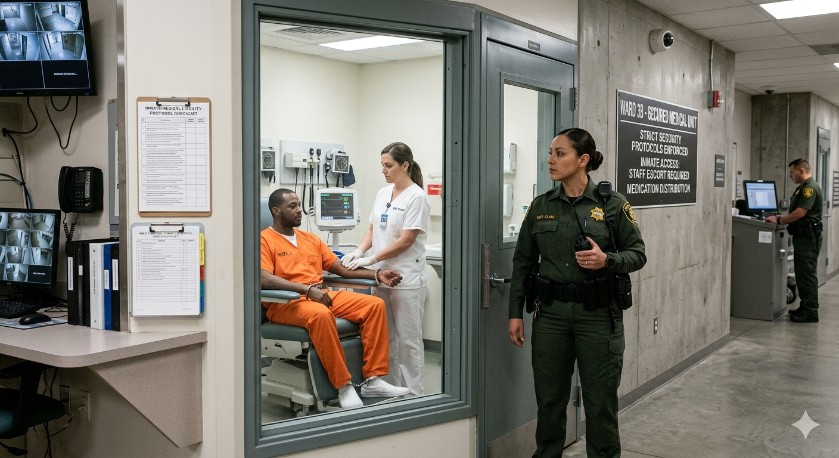
Security failures in medical units create liability exposure distinct from clinical failures. The NCCHC Standards establish security-by-design requirements that address specific vulnerabilities in correctional healthcare security. These standards cover entry control hardware, waiting area management, and the critical control of medications and sharps.
Entry control requires specific doors and hardware to manage inmate flow, staffed control posts at entry points, and emergency communication equipment. Waiting areas demand particular attention to location and capacity to prevent interference, harassment, and control problems. When inmates congregate in poorly designed waiting spaces, the risk of violence escalates—a serious concern for security for prison nurses and other clinical staff.
The physical layout must accommodate clear lines of sight throughout the unit. Supervision of inmate patients requires visual monitoring capabilities that allow staff to observe patient behavior while maintaining clinical privacy. This balance proves challenging but essential for jail healthcare security protocols.
Workplace safety represents a paramount concern in these environments. Given the documented risks of violence in correctional medical settings, administrators must prioritize protective measures. Recent analyses of Inmate Attacks against Medical Staff highlight how inadequate safety protocols and staffing shortages create dangerous conditions for healthcare workers. These incidents underscore why physical security design must anticipate and mitigate violence risks.
Entry Control and Waiting Area Management
Controlled inmate entry through designated access points prevents unauthorized access to clinical areas. Staffing posts at these entry points should maintain rosters of expected patients and verify identities before granting access. Waiting areas should be sized to prevent overcrowding and positioned to minimize interaction with general population traffic. Seating arrangements should allow custody to observe without compromising medical privacy.
Medication Storage and Sharps Security
Medications, needles, and sharp instruments present unique weaponization risks in correctional settings. Security protocols require locked storage for all drugs, with inventory controls and access logs. Sharps require locked cabinets within clinical areas, with strict accountability for every needle and scalpel. Line-of-sight considerations ensure clinical staff can monitor these items during use while maintaining awareness of inmate positioning. Never leave sharps unattended, even momentarily.
Authority Boundaries Between Custody and Clinical Staff
Perhaps no area creates more tension—and liability—than the boundary between custody authority and medical decision-making. The American Medical Association (AMA) has long-held ethical policies that clarify this relationship unequivocally: medical decisions are the exclusive domain of qualified health care professionals. Wardens, guards, and other custody officials cannot make medical decisions for incarcerated patients or override clinical judgment.
This principle carries profound implications for correctional healthcare liability. Physicians and other licensed providers retain exclusive authority over clinical decisions; they cannot delegate prisoner-patient decision-making authority to custody officials. While custody staff may offer safety recommendations based on security concerns, these recommendations must not interfere with necessary medical treatment.
When custody overrides clinical judgment—for instance, denying an inmate access to urgent care because of disciplinary status or staffing shortages—the facility risks deliberate indifference claims. Security concerns might justify delayed transport or modified escort procedures, but they cannot justify denial of care. The AMA guidance emphasizes that institutional responsibility for correctional health requires clear policies establishing that medical necessity trumps administrative convenience, though safety protocols may modify the method of delivery.
Facilities should implement written agreements between security and medical leadership that define these boundaries. When disputes arise, a designated chain of escalation should resolve conflicts without compromising patient care. Documentation of custody recommendations and clinical responses protects both security staff and medical providers when lawsuits allege improper interference with treatment.
Documentation and Grievance Management for Risk Mitigation
The PLRA exhaustion requirement creates powerful incentives for disciplined documentation. Under 42 U.S.C. §1997e, inmates must exhaust administrative remedies before filing suit. This means your facility’s daily handling of request slips, triage decisions, and grievance responses builds the defensive record that may defeat litigation.
Effective risk management for correctional facilities requires treating every health request as potential evidence. When health-care staff review slips daily, notify inmates of decisions in writing, and maintain controlled access to request systems, they create an administrative record that satisfies exhaustion defense requirements. These practices simultaneously reduce repeat grievances by providing clear communication about care timelines and clinical rationales.
To demonstrate constitutional adequacy, documentation must capture clinical reasoning, not just check-boxes. When a nurse triages a non-urgent request to the next available sick call, the file should reflect the clinical indicators supporting that decision. Similarly, when custody delays transport for legitimate security reasons, documentation should note the specific threat and the alternative measures taken to ensure timely care.
Implementing Comprehensive Compliance and Protection Programs
Federal and state benchmarks provide the framework for comprehensive compliance. The Federal Bureau of Prisons provides essential medical, dental, and mental health services consistent with accepted community standards for a correctional environment. BOP operates seven medical referral centers for advanced care, establishing a benchmark for adequate infrastructure in larger systems.
Federal legislation, such as the Correctional Officers Health and Safety Act of 1998, drives specific protocols for managing infectious diseases, requiring guidelines for prevention, detection, and treatment that protect both inmates and correctional employees. These federal standards inform state facility expectations even where direct applicability is limited.
State statutory duties often exceed federal minimums. For example, Code of Virginia Title 53.1 requires intake medical examinations by licensed physicians, nurse practitioners, or physician assistants upon arrival, with additional exams required within 30 days prior to certain work assignments. Virginia law explicitly prohibits denying medically necessary services due to an inmate’s inability to pay—a protection that reflects the institutional responsibility for correctional health regardless of fiscal considerations.
Credentialing standards complete the compliance picture. BOP utilizes licensed and credentialed providers supported by community consultants. Facilities should verify licenses, conduct background checks, and ensure continuing education specific to correctional environments. These standards support prison medical staff safety by ensuring competence in high-risk clinical settings.
Conclusion
Protecting your facility from liability requires mastering three core principles: First, constitutional liability demands proof of deliberate indifference, not mere malpractice—know the knowledge standard and document accordingly. Second, PLRA exhaustion rules mean your administrative processes are your first line of legal defense; treat every grievance and request slip as potential litigation evidence. Third, physical security protocols and clear authority boundaries between custody and clinical staff protect both personnel and patients from harm.
By aligning your sick-call systems, security designs, and documentation practices with NCCHC guidelines and federal constitutional standards, you create a defensible framework that minimizes exposure while delivering constitutionally adequate care. Review your current protocols against these benchmarks today, and close the gaps before they become exhibits in federal court.