

Weather Car Accident Fault: Act of God Defenses in USA
You’re driving home when a sudden downpour turns the highway into a slick surface. Within seconds, you’re skidding into another vehicle—or someone slides into you. When the police arrive, the other driver claims the storm was an “act of God,” insisting no one is to blame. Understanding weather car accident fault becomes critical because bad weather does not automatically erase liability. This guide breaks down how courts determine responsibility, when the act of God defense applies, and how to protect your rights after a crash involving rain, snow, or fog.
Understanding Weather Car Accident Fault and the Act of God Defense
The Federal Highway Administration defines a weather-related crash as one occurring in adverse atmospheric conditions such as rain, sleet, hail, snow, freezing rain or drizzle, fog, smog, smoke, severe crosswinds, or blowing snow, sand, soil, or dust [^1^]. These environmental factors contribute to approximately 21% of all vehicle crashes nationwide, yet they rarely excuse drivers from legal responsibility.
To understand why, you must first grasp the legal definition act of God under American tort law. According to the Cornell Law School Legal Information Institute, an act of God is a severe, unanticipated natural event for which no human is responsible [^2^]. Courts treat this as an affirmative defense that attempts to break the chain of causation in negligence claims. For the defense to succeed, the weather event must be truly extraordinary—think sudden flash floods or unforeseeable microbursts—rather than ordinary rain or seasonal snow.
Negligence claims require four elements: duty, breach, causation, and harm [^3^]. Every driver owes a duty of reasonable care to others on the road. When someone breaches that duty—by driving too fast for conditions or failing to maintain safe following distance—they cause harm and become liable. An act of God defense car accident strategy argues that the weather, not the driver, was the sole proximate cause of the crash. However, courts generally reject this defense when the weather was foreseeable or when the driver failed to adjust behavior accordingly [^2^].
Is anyone automatically at fault in a weather-related crash? No. Liability depends on specific conduct and state law standards. Can bad weather excuse a driver from liability? Only when the event was truly unforeseeable and the driver exercised all reasonable precautions. When determining fault in car accidents, attorneys examine whether the storm was predictable and whether the driver ignored warnings. For detailed guidance on how these principles apply in specific jurisdictions, you can review resources on Weather-related accident liability.
National Data on Weather-Related Crashes and Liability Scope
The scope of weather-related accident responsibility in the United States is staggering. According to 10-year averages from the Federal Highway Administration, over 1.2 million vehicle crashes annually are weather-related, resulting in nearly 6,000 fatalities and over 445,000 injuries each year [^1^]. These figures establish that adverse weather is not merely an inconvenience but a significant public safety crisis with complex liability implications.
Breaking down the USA weather crash statistics reveals clear patterns. Data shows that 46% of weather-related crashes happen during rainfall and 17% occur during snow or sleet. When analyzing road surface conditions, 70% of these crashes happen on wet pavement and 40% occur on snowy or icy pavement [^1^]. This distinction matters legally because a driver might argue they could not anticipate black ice (surface condition) even if snow (atmospheric condition) was forecast.
These statistics demonstrate that drivers face predictable hazards regularly. When nearly three-quarters of weather crashes happen in rain, courts generally consider wet roads foreseeable. This foreseeability undermines most act of God defenses, reinforcing that weather-related accident responsibility remains a critical consideration for every motorist.
How Weather Car Accident Liability Works by Storm Type
Weather car accident liability varies significantly depending on the specific meteorological conditions present. The Federal Highway Administration categorizes these events to help analysts understand causation, and courts use similar frameworks to assess whether drivers exercised reasonable care.
Rain and wet pavement are the most common hazards, with 46% of weather-related crashes occurring during rainfall and 70% happening on wet pavement [^1^]. Wet pavement reduces friction and increases stopping distances. Hydroplaning—when tires lose contact with the road surface—typically results from worn tread or excessive speed rather than unforeseeable acts of nature. Fog creates visibility challenges that require specific safety measures. The National Weather Service advises drivers to use low-beam headlights in fog and to pull into safe locations when visibility approaches zero [^5^]. Failure to follow this guidance often constitutes negligence.
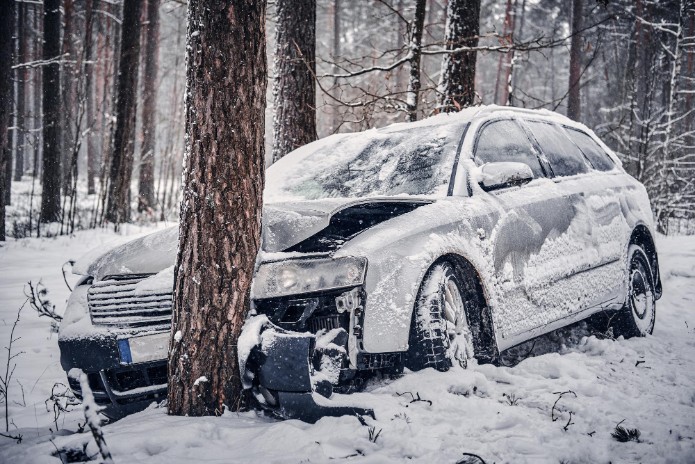
Snow and ice present unique traction challenges. While black ice can appear suddenly, drivers in northern climates are generally expected to anticipate winter conditions and equip vehicles appropriately. Simply losing control does not automatically invoke an act of God defense unless the event was truly unforeseeable and unavoidable despite reasonable precautions.
Snow and Ice Accidents: Who Is at Fault?
When crashes occur on snowy or icy pavement—which accounts for 40% of weather-related crashes—or during active snowfall/sleet (17%), liability analysis focuses on driver expectations. While black ice may seem sudden, courts typically expect drivers in susceptible regions to anticipate winter hazards. Rear-end collisions on ice usually indicate following too closely or driving too fast for conditions rather than an unavoidable natural event. Drivers must reduce speed and increase following distance when traction decreases, regardless of posted limits.
Rain and Hydroplaning Liability
With a large percentage of weather crashes occurring in rainy conditions on wet pavement, rain accident blame frequently centers on tire maintenance and speed control. Hydroplaning generally results from worn tires or excessive velocity rather than extraordinary natural forces. Successfully claiming an act of God defense for hydroplaning requires proving truly exceptional circumstances, such as sudden microbursts or flash flooding that no reasonable driver could anticipate. Standard rainfall rarely qualifies as unforeseeable, making this defense difficult to maintain in typical shower conditions.
The “Too Fast for Conditions” Standard and Driver Duty
One of the most critical concepts in bad weather car crash defense cases is the “too fast for conditions” standard. The Federal Motor Carrier Safety Administration defines this as traveling at a speed greater than a reasonable standard for safe driving under adverse weather circumstances [^6^]. This standard applies to all drivers, though commercial operators face heightened scrutiny.
Posted speed limits represent maximums for ideal conditions—not minimums for storms. You can drive below the posted limit and still be negligent if your speed was unreasonable for the visibility, traction, and precipitation present. For example, driving 45 mph in a 55 mph zone during dense fog may still constitute negligence if visibility is severely limited.
Commercial drivers holding CDLs face elevated expectations under FMCSA regulations. These professionals must exercise superior judgment regarding speed management and stopping distance given their extensive training and vehicle capabilities. When a commercial truck jackknifes on wet pavement, investigators examine logbooks, telematics data, and weather reports to determine whether the operator adjusted appropriately for conditions.
Courts assess whether a reasonable person would have reduced speed or postponed travel given the known hazards. This objective standard makes too fast for conditions a powerful tool for plaintiffs and a difficult defense for drivers who assumed posted limits guaranteed safety regardless of atmospheric realities.
Comparative Negligence and Evidence in Weather Crashes
When multiple vehicles collide during snowstorms or fog banks, unforeseen weather accident claim issues become complex. States follow different negligence frameworks that dramatically affect recovery. Under contributory negligence, any plaintiff negligence bars recovery entirely, while comparative negligence systems allow recovery reduced by the plaintiff’s percentage of fault [^7^].
Multi-vehicle pileups on icy interstates illustrate these principles. The first vehicle may have stopped appropriately, while subsequent drivers failed to adjust speed for whiteout conditions. Courts allocate fault percentages based on each driver’s conduct relative to the weather. Chain-reaction causation analysis requires distinguishing between atmospheric conditions (falling snow, fog density) and road surface states (ice accumulation, slush depth) to determine which factors actually caused specific impacts.
Proving weather car accident fault requires concrete evidence. Essential documentation includes: – Official weather records from NWS archives or airport METARs – DOT Road Weather Information System (RWIS) data showing surface temperatures and conditions – Police crash reports noting both atmospheric and pavement conditions – Timestamped photographs showing visibility and road surface – Dashcam footage capturing precipitation intensity and driver reactions – Event Data Recorder (EDR) or telematics showing speed, braking, and steering inputs – Roadway camera footage from traffic management centers
These evidentiary sources help establish whether the weather was truly extraordinary or merely challenging, and whether drivers exercised reasonable caution under the circumstances.
Insurance Coverage: Collision vs. Comprehensive in Bad Weather
Understanding ice car accident insurance and other coverage types helps drivers navigate post-crash financial recovery. The National Association of Insurance Commissioners clarifies that comprehensive coverage reimburses damage not caused by collision—such as hail, falling trees, or flooding—while collision coverage applies to vehicle-to-vehicle or vehicle-to-object crashes regardless of weather [^8^].
Neither coverage is required by state law, though lenders typically mandate both for financed or leased vehicles [^9^]. This distinction becomes crucial when a driver slides on ice into a guardrail versus when a tree limb falls on a parked car during a storm. The first scenario triggers collision coverage; the second triggers comprehensive.
Insurers often attempt bad weather car crash defense tactics by blaming atmospheric conditions to deny negligence claims. They may argue that hydroplaning was unavoidable or that ice constituted an act of God. However, coverage determinations focus on the mechanical event—collision versus other-than-collision—rather than fault. Subrogation allows carriers to shift fault claims between insurers after initial payouts, meaning your carrier might pursue the other driver’s insurer if evidence reveals negligent speed despite the storm.
When filing claims, document whether you hit another vehicle, a fixed object, or suffered damage from falling debris. This classification determines which coverage applies and whether subrogation rights arise between carriers.
Protecting Your Rights After a Weather-Related Accident
Immediate actions following a storm-related crash significantly impact your ability to recover damages. First, document weather conditions immediately. Take timestamped photos of precipitation, road surfaces, and visibility before conditions change. Obtain police reports that specifically note both atmospheric conditions (rain, snow, fog) and road surface states (wet, icy, slushy).
Avoid admitting fault at the scene. Statements like “I couldn’t see anything” or “the ice came out of nowhere” can undermine your position later, even if you were driving appropriately. Instead, focus on exchanging information and seeking medical attention for any injuries.
Ignored weather warnings or advisories carry significant weight in establishing foreseeability. If the other driver proceeded despite National Weather Service alerts for severe conditions, this evidence undermines any act of God defense they might raise. Courts view such warnings as putting reasonable drivers on notice that extraordinary caution—or trip postponement—is required.
Because state laws regarding negligence, comparative fault, and act of God defenses vary significantly, consulting an attorney early protects your interests. An experienced legal team can analyze weather data, interview witnesses, and challenge insurer attempts to blame the storm for avoidable collisions. For those seeking dedicated advocacy after serious injuries, Cameron Law provides expert personal injury representation to help navigate these complex claims and secure fair compensation.
Conclusion
Weather complicates car accident liability, but it rarely eliminates it. First, remember that the act of God defense applies only to severe, unanticipated natural events—not ordinary rain or snow. Second, drivers must adjust speed and following distance to match conditions; simply driving the posted limit does not guarantee safety or legal protection. Third, documenting conditions immediately and understanding your insurance coverage types strengthens your position against insurers who might blame the storm. When weather car accident fault disputes arise, evidence and state-specific negligence laws determine the outcome. Stay safe by anticipating hazards, and know your rights if the weather turns dangerous.