

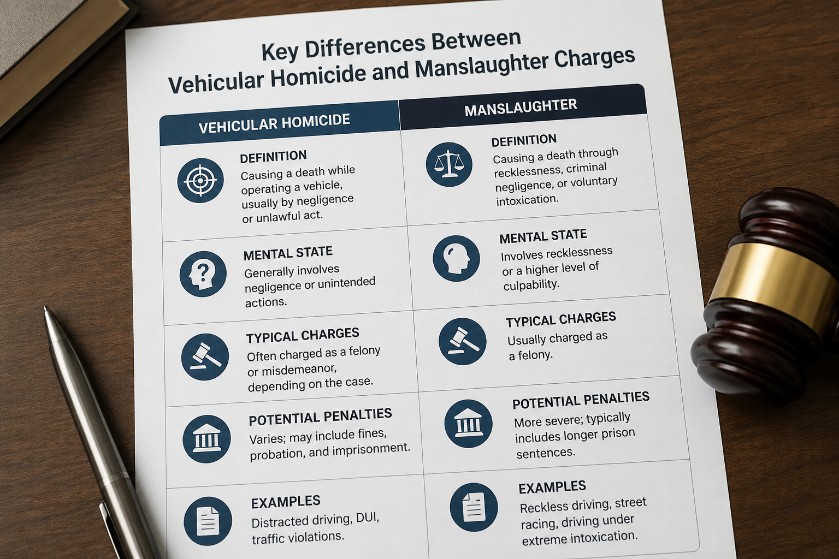
Key Differences Between Vehicular Homicide and Manslaughter Charges
Imagine receiving a phone call that changes everything. You were behind the wheel during a crash, and now someone has died. Suddenly, you’re facing terms like “vehicular homicide” and “manslaughter,” and you cannot tell if they mean the same thing or carry different consequences. You’re not alone in this confusion. If you are searching for clarity on vehicular homicide vs manslaughter, you need accurate information quickly. This article explains the critical distinctions between these charges, how state and federal laws treat fatal crashes differently, and what steps you should take to protect your future. Understanding these differences could mean the difference between years in prison and a viable defense strategy.
What Is Vehicular Homicide vs Manslaughter?
According to the Cornell Legal Information Institute, vehicular homicide occurs when the illegal or negligent operation of a motor vehicle leads to another person’s death. The same source notes that jurisdictions often use overlapping labels, including automobile homicide and vehicular manslaughter, to describe this conduct. Justia confirms that these laws vary significantly by state, with some prosecutors historically charging these deaths as involuntary manslaughter rather than under specific vehicular statutes.
So what is the difference between vehicular homicide and vehicular manslaughter? In many jurisdictions, the terms are functionally synonymous. However, Cornell LII explains that vehicular manslaughter specifically refers to unlawful or negligent driving that results in death, while vehicular homicide statutes may carry distinct grading or sentencing provisions depending on the state. The terminology you encounter depends entirely on where the crash occurred.
Is vehicular homicide the same as involuntary manslaughter? Historically, vehicular homicide evolved from involuntary manslaughter statutes. Justia notes that some states still fold these offenses into general involuntary manslaughter provisions rather than maintaining separate vehicular statutes. The critical distinction lies in the mens rea requirement: Cornell LII observes that vehicular homicide is generally easier to prove than manslaughter because it requires a less culpable mental state—often mere negligence rather than the recklessness typically required for manslaughter convictions.
Do states use the term “vehicular homicide” at all? Yes, but usage varies dramatically. While some states employ specific vehicular homicide statutes, others classify the same conduct under broader homicide categories. Understanding Vehicular homicide vs. manslaughter requires examining your specific jurisdiction’s statutory language, as the labels control the proof requirements and potential penalties you face. When facing vehicular manslaughter charges, you must understand exactly which mental state the prosecution must prove to avoid unexpected enhancements.
Federal and State Legal Frameworks in the USA
Federal jurisdiction over vehicular deaths is limited. Under 18 U.S.C. § 1112, manslaughter is defined as an unlawful killing without malice, divided into voluntary and involuntary categories. This statute applies only within the special maritime and territorial jurisdiction of the United States, meaning the vast majority of fatal crashes—those occurring on ordinary highways and streets—fall exclusively under state prosecution.
The Cornell Legal Information Institute explains that federal law distinguishes voluntary manslaughter—an intentional killing in the heat of passion after adequate provocation—from involuntary manslaughter, which involves negligently causing death. Under federal law, voluntary manslaughter carries penalties of up to 15 years imprisonment, while involuntary manslaughter is punishable by up to 8 years imprisonment.
However, most fatal vehicle crashes are prosecuted under state law. Does federal law define manslaughter differently than state law? While the general concepts align, state statutes often diverge significantly in terminology and grading. Some states maintain specific vehicular homicide statutes, while others fold these offenses into general manslaughter or criminally negligent homicide statutes. Justia confirms that no universal definition exists across jurisdictions, and the criminal vehicular homicide definition varies dramatically depending on whether you are in federal or state court. Do states use the term vehicular homicide at all? Yes, but some use alternative labels like automobile homicide or simply classify the conduct under general manslaughter provisions. Understanding these frameworks across the USA matters because your defense strategy must account for which sovereign is prosecuting you and which specific statutory language controls the charges filed against you.
The Mental State Divide: Recklessness, Negligence, and Intent
The primary distinction between these charges lies in the mens rea, or mental state, required for conviction. Cornell LII notes that vehicular homicide generally requires only negligence or illegal operation, making it easier to prove than manslaughter. In contrast, manslaughter typically requires recklessness—a higher culpable mental state that demonstrates conscious disregard for human life.
To understand this distinction concretely, consider the Texas Penal Code Chapter 19 framework. Texas defines manslaughter under § 19.04 as recklessly causing the death of an individual, while § 19.05 establishes criminally negligent homicide as causing death by criminal negligence. This statutory structure creates a clear charging ladder: negligence sits at the bottom, recklessness in the middle, and implied malice or intent at the top approaching murder.
What mental state is required for vehicular homicide vs manslaughter? Prosecutors filing vehicular homicide or criminally negligent homicide charges often need to prove you operated the vehicle with criminal negligence. This is more than a simple mistake; it means you failed to perceive a substantial and unjustifiable risk that a reasonable person would have recognized—for example, running a red light you ought to have seen. For manslaughter, they must demonstrate you consciously disregarded a known and substantial risk, such as driving at extreme speeds through a school zone. How do states define “reckless” vs “negligent” driving in death cases? Reckless driving resulting in death involves conscious disregard for safety, while negligence involves failure to perceive risks a reasonable person would recognize. How does “criminally negligent homicide” fit into the charging ladder? It serves as the entry-level homicide offense for deaths caused by criminal negligence rather than recklessness. This legally distinguishes a tragic but non-criminal accident from a death caused by a person’s failure to recognize a substantial and unjustifiable risk.
Criminally Negligent Homicide vs. Manslaughter
The Texas framework illustrates how states grade deaths caused by negligence rather than recklessness. Under Texas Penal Code § 19.05, criminally negligent homicide is a state jail felony, while § 19.04 manslaughter is a second-degree felony carrying harsher penalties. This distinction matters because the same fatal crash could result in significantly different sentences depending on whether the prosecution can prove you recognized the risk (recklessness) or merely failed to perceive it (negligence).
DUI Manslaughter vs Vehicular Homicide in Drunk Driving Cases
Intoxication significantly complicates charge selection in fatal crashes. While some states treat impairment as an aggravating factor, others maintain separate statutes for DUI manslaughter. Does intoxication automatically make a case vehicular homicide? No, it does not universally elevate charges, though it may trigger specific statutory provisions depending on jurisdiction.
Justia explains that drunk driving death charges vary by state. Some jurisdictions automatically consider impairment evidence of recklessness, while others require additional showing of dangerous driving beyond mere intoxication. Florida provides a useful comparative framework. Under Florida Statutes § 782.071, vehicular homicide involves operating a vehicle in a reckless manner likely to cause death or great bodily harm. While this statute addresses reckless driving generally, Florida separately recognizes DUI manslaughter as a distinct offense with its own elements.
What is the difference between DUI manslaughter and vehicular homicide? Generally, DUI manslaughter requires proof of intoxication plus causation of death, while vehicular homicide requires proof of reckless driving regardless of impairment. Can both charges be filed for the same crash? Typically, prosecutors charge these as alternatives rather than stacking both, but statutory frameworks vary by jurisdiction. Understanding whether your state treats impairment as a standalone crime or merely as evidence of recklessness determines your exposure to drunk driving death charges and potential sentencing enhancements. The presence of alcohol does not automatically prove the conscious disregard for risk required for manslaughter in every jurisdiction.
Vehicular Homicide Penalties and Vehicular Manslaughter Penalties
Is vehicular homicide always a felony? In virtually all jurisdictions, yes. The specific grading, however, varies significantly by statute. Florida Statutes § 782.071 classifies vehicular homicide as a second-degree felony, but elevates the offense to a first-degree felony if the driver failed to render aid or provide information after the crash. This enhancement demonstrates exactly how penalties change if the driver left the scene, potentially adding years to a sentence.
Under Texas Penal Code § 19.04, manslaughter is a second-degree felony carrying substantial prison time, while § 19.05 criminally negligent homicide is a state jail felony with lesser—but still serious—consequences. For comparison, federal penalties under 18 U.S.C. § 1112 reach up to 15 years imprisonment for voluntary manslaughter and 8 years for involuntary manslaughter within federal jurisdiction.
Are penalties different when the victim is a passenger vs another driver? Some jurisdictions consider the relationship and duty owed, but generally the driver’s conduct matters more than the victim’s identity or location. What happens to a driver’s license after a conviction? Justia notes that states typically impose automatic license suspension or revocation upon conviction, often for extended periods or permanently. These vehicular manslaughter penalties and vehicular homicide penalties extend beyond prison time to include lifelong collateral consequences affecting employment, housing, and civil rights. The financial burden of restitution to victims’ families often accompanies these criminal sanctions.
License Suspension and Administrative Consequences
Beyond criminal penalties, states impose severe administrative consequences. Justia confirms that conviction typically triggers automatic license suspension or revocation, often for years or permanently. These administrative penalties operate independently of criminal sentencing, meaning you may lose driving privileges even if you avoid prison time, or face extended suspension periods beyond your incarceration. Understanding these collateral consequences is essential when evaluating plea offers or trial strategies.
How State Laws Vary Across the USA
No universal definition governs these charges nationwide. How much do penalties vary by state for these charges? The differences can be dramatic, ranging from state jail felonies to first-degree felonies depending on jurisdiction, specific conduct, and whether aggravating factors like fleeing the scene apply.
Some states maintain specific vehicular homicide statutes. Florida Statutes § 782.071 creates a distinct offense for killings caused by reckless driving, and notably includes the killing of an unborn child by injury to the mother within its scope. Do states use the term “vehicular homicide” at all? Yes, Florida explicitly does, but others take fundamentally different approaches.
Texas, conversely, classifies these deaths under general homicide statutes. Texas Penal Code § 19.01 establishes that criminal homicide includes murder, capital murder, manslaughter, and criminally negligent homicide—meaning vehicle-related deaths fall under the latter two categories depending on the mental state proved. Whether a prosecutor files under “automobile homicide,” “vehicular manslaughter,” or general manslaughter depends entirely on statutory language available in that state.
Cornell LII emphasizes that statutory language controls the applicable framework and proof requirements. Justia confirms that penalties vary dramatically by state, with some jurisdictions treating these as the most serious felonies short of murder. You cannot assume that what applies in one jurisdiction applies in another, making localized legal counsel essential for accurate assessment of your exposure and available defenses.
Vehicular Homicide vs Murder: When Prosecutors Elevate Charges
Can a prosecutor charge murder for a fatal car crash? Yes, under specific circumstances involving extreme culpability. While most fatal crashes support only manslaughter or vehicular homicide charges, conduct demonstrating extreme recklessness or depraved indifference to human life can elevate the charge to murder.
Cornell LII explains that voluntary manslaughter involves intentional killing in the heat of passion after adequate provocation. What is “heat of passion” and why does it matter for manslaughter? This doctrine reduces murder to manslaughter when a defendant acts under sudden intense emotion rather than premeditation. However, this rarely applies to vehicle cases unless road rage escalates to intentional homicide, creating a brief but legally significant emotional disturbance.
More relevant to vehicular conduct is the concept of implied malice or depraved heart murder. Under Texas Penal Code § 19.01, murder includes intentionally or knowingly causing death, or causing death during the commission of certain felonies. Extreme recklessness—such as evading police at high speeds through crowded school zones or driving with multiple prior DUIs despite knowing the risks—may demonstrate the “malice aforethought” required for murder charges.
Most fatal crashes do not support murder charges unless extreme recklessness or intent is proven. However, certain fact patterns, including prior DUIs, fleeing the scene of a previous crash, or driving with a revoked license, may trigger murder prosecutions depending on state law. Understanding the critical line between vehicular homicide vs murder requires analyzing whether your conduct showed conscious disregard for human life so extreme it constituted malice rather than mere recklessness.
Finding a Vehicular Manslaughter Lawyer and Defense Strategies
If you are facing charges, immediate legal intervention is critical. What defenses are common in vehicular homicide cases? Effective strategies include challenging causation—proving the death resulted from intervening factors beyond your driving or equipment failure—disputing the prosecution’s characterization of your mental state as reckless rather than merely negligent, and questioning the validity of traffic stops or chemical tests that led to evidence against you.
What happens to a driver after charges are filed? You will face initial court appearances, potential pre-trial detention, and the immediate commencement of administrative license suspension proceedings separate from your criminal case. The high-stakes nature of these charges, carrying potential decades of imprisonment, demands experienced counsel who understands both the criminal and collateral consequences you face.
When seeking a vehicular manslaughter lawyer, look for attorneys with specific experience in death resulting from vehicle cases, familiarity with accident reconstruction experts, and substantial trial experience in your specific jurisdiction. For those in Central Texas requiring local criminal defense expertise regarding these serious charges, The Law Office of Ryan Deck provides representation informed by knowledge of Williamson County courts and Texas homicide statutes. Regardless of your location, you need counsel who understands the nuanced differences between negligence and recklessness, can challenge forensic evidence, and will protect your constitutional rights through every stage of the process.
Understanding the distinction between these charges can shape your entire defense strategy and future. First, mens rea matters enormously: the difference between negligence, recklessness, and intent creates entirely different charging levels and sentencing exposure. Second, state law varies significantly—what constitutes vehicular homicide in Florida may be classified as manslaughter or criminally negligent homicide in Texas, affecting everything from plea negotiations to trial strategy. Third, penalties are severe and life-altering, extending far beyond prison sentences to include permanent license revocation, financial ruin from restitution, and lifelong collateral consequences affecting employment and housing. If you or a loved one faces these charges, consult a qualified criminal defense attorney immediately to protect your rights, your freedom, and your future.