

DUI Breathalyzer Defense: How to Challenge Results in Court
You’re sitting in the back of a patrol car, watching the digital display flash a number that doesn’t match how you feel. Maybe you had one drink with dinner an hour ago, or perhaps you’re diabetic and haven’t eaten since lunch. Suddenly, that machine’s reading is threatening your license, your job, and your freedom. If you’re facing charges based on a breath test result, you’re not powerless. Understanding how these devices actually work, what constitutional protections you have, and where errors commonly occur can transform your defense. This guide walks you through the federal standards governing breath alcohol testing, your Fourth Amendment rights at a traffic stop, and specific strategies for challenging evidence in court.
How Evidential Breath Testing Devices Work
Breath alcohol measurement relies on indirect sensing technology that estimates your blood alcohol concentration (BAC) by analyzing the alcohol present in your exhaled breath. According to the National Highway Traffic Safety Administration (NHTSA), alcohol measurement devices—whether stationary or portable—function as sensors that measure a driver’s breath alcohol concentration (BrAC), displaying a numerical value after the driver blows into a mouthpiece (NHTSA Alcohol Measurement Devices). This BrAC reading serves as the evidentiary cornerstone in most impaired driving prosecutions, yet its accuracy depends entirely on the device type and adherence to rigorous federal protocols.
The federal framework distinguishes between two primary categories of breath testing equipment. NHTSA maintains model specifications for evidential breath test (EBT) devices, alcohol screening devices (ASDs), calibrating units (CUs), and breath alcohol ignition interlock devices (BAIIDs) (NHTSA Alcohol Measurement Devices). These specifications form the baseline for the Conforming Products Lists (CPLs)—rosters of devices NHTSA has independently tested and verified as meeting federal standards (NHTSA Alcohol Measurement Devices). While states maintain their own approval processes for courtroom evidence, the NHTSA CPL represents the federal gold standard that underpins most state admissibility determinations.
For Department of Transportation workplace testing, regulations explicitly mandate that only CPL-listed EBTs may be used for confirmation tests under 49 CFR Part 40 (DOT ODAPC Approved Evidential Breath Testing Devices). These federal requirements provide a critical benchmark for evaluating device reliability in criminal cases, even though DOT rules technically apply only to workplace screening.
EBT vs. PBT: Evidentiary and Probable Cause Roles
NHTSA classifications draw a sharp line between evidential and screening functions. Preliminary breath test (PBT) devices are handheld units deployed during roadside investigations to help establish probable cause for arrest (NHTSA Countermeasures That Work). These screening devices are rarely used as evidence in court, serving instead as investigatory tools. In contrast, evidential breath test (EBT) devices are state-approved units typically operated at police stations or checkpoints, and their results can be admitted as evidence in court proceedings (NHTSA Countermeasures That Work). This distinction matters because constitutional challenges often hinge on whether officers had valid probable cause—sometimes established through PBTs—before administering the evidentiary test.
NHTSA Conforming Products Lists and Device Standards
Devices earn placement on the CPL only after NHTSA conducts independent testing to verify conformity with model specifications (NHTSA Alcohol Measurement Devices). This federal approval process ensures that listed devices meet stringent accuracy and reliability criteria. Defense attorneys routinely verify whether the specific unit used in an arrest appears on the current CPL, as deviation from these federal standards can undermine the prosecution’s claims of breathalyzer accuracy in court. The CPL status serves as an initial filter for device reliability; if the machine wasn’t federally certified, its readings face immediate scrutiny.
Constitutional Rights at a Traffic Stop and Warrant Requirements
Your Fourth Amendment protections do not vanish when blue lights appear in your rearview mirror. The Supreme Court has established clear boundaries regarding when police may compel chemical testing. In Birchfield v. North Dakota, the Court held that the Fourth Amendment’s “search incident to arrest” doctrine permits warrantless breath tests following a lawful DUI arrest, but explicitly found that the same doctrine does not permit warrantless blood tests. The Court reasoned this distinction by finding breath tests are significantly less physically intrusive than blood tests, which require piercing the skin.
However, Birchfield does not create unlimited authority for warrantless searches. The Court acknowledged that implied consent laws—statutes that require drivers to submit to testing as a condition of using public roads—play a role in the constitutional analysis, though the decision focused on the search-incident-to-arrest doctrine rather than consent penalties (Cornell LII – Birchfield v. North Dakota). This creates a constitutional floor that applies nationwide: officers may demand breath samples without warrants following lawful arrest, but blood draws require additional justification.
For blood testing specifically, Missouri v. McNeely rejected the notion of per se exigency, ruling that officers must generally obtain warrants when they can reasonably do so without undermining the search’s efficacy (Justia – Missouri v. McNeely). This case-by-case approach means that natural alcohol dissipation alone does not justify bypassing the warrant requirement. Historical context from Schmerber v. California further illuminates the limits: the Court in that foundational case approved a warrantless blood draw only because it was taken by a physician in a hospital, involved minimal risk, and occurred under exigent circumstances where there was no time to secure a warrant (Justia – Schmerber v. California).
Warrantless Searches Under Birchfield v. North Dakota
The 2016 Birchfield decision created a bright-line rule for breath testing. Because breath tests merely require blowing into a tube and do not extract bodily fluids, the Court found them reasonable under the search-incident-to-arrest exception. This means police may require you to submit to a breath test without first rushing to a magistrate, provided your arrest was lawful. However, this permission applies only to breath; blood tests remain protected by the warrant requirement unless exigent circumstances truly prevent obtaining one.
Case-by-Case Exigency Analysis After McNeely
McNeely fundamentally changed how courts evaluate blood draw evidence. Rather than accepting that alcohol dissipation always creates an emergency, judges now examine whether officers had time to seek warrants given the specific circumstances. If officers delayed unnecessarily or could have telephonically obtained authorization, blood evidence may be suppressed. This framework supports potent suppression motions when police bypass the warrant requirement without justification, particularly in jurisdictions where magistrates are readily available around the clock.
Common Causes of False Breathalyzer Readings
Breath test devices do not actually measure blood alcohol directly; they infer it from breath samples, creating multiple opportunities for error. Medical conditions like diabetes, GERD, and ketosis can generate isopropanol or acetone compounds that machines may misinterpret as ethanol. The DOT acknowledges this interference risk explicitly: federal regulations require that EBTs used for confirmation testing must distinguish alcohol from acetone at the 0.02 concentration level (DOT ODAPC Approved Evidential Breath Testing Devices). This requirement proves that acetone interference is a documented, known issue rather than a theoretical defense.
Mouth alcohol contamination presents another vulnerability. Residual alcohol trapped in dental work, mouthwash used minutes before the stop, or regurgitation from acid reflux can create localized alcohol concentrations that far exceed your actual blood levels. If officers fail to observe a proper deprivation period—typically requiring you to refrain from eating, drinking, smoking, or vomiting for fifteen to twenty minutes prior to testing—this mouth alcohol skews BrAC readings dramatically upward.
Environmental factors compound these risks. Residual vehicle fumes, calibration drift from temperature fluctuations, and radio frequency interference can all affect sensor accuracy. These variables create reasonable doubt about whether the BrAC reading truly reflects your impairment level at the time of driving, particularly when officers deviate from standardized protocols.
Mouth Alcohol Contamination and Medical Interference
Residual alcohol in the oral cavity behaves differently than alcohol metabolized in your bloodstream. When you burp, regurgitate, or even use alcohol-based mouthwash shortly before testing, the device measures concentrated vapors rather than deep lung air. Similarly, diabetic ketoacidosis or fasting ketosis produces acetone naturally, and while modern devices must filter these compounds per DOT standards, improper maintenance or outdated software may allow false positives to slip through (DOT ODAPC Approved Evidential Breath Testing Devices).
Operator Error and Observation Periods
Human error introduces uncertainty into even properly calibrated machines. Officers must follow standardized observation protocols to ensure you haven’t introduced mouth alcohol or compromised the test. Failure to document a continuous observation period, improper device handling, or testing performed too quickly after you exit the vehicle all introduce variables that defense counsel can exploit. These procedural gaps directly impact the legal admissibility of the breath test by undermining the foundational reliability the prosecution must prove in court.
Breathalyzer Calibration Issues and Federal Device Standards
Attacking DWI evidence often requires scrutinizing the machine itself. NHTSA’s model specifications for evidential breath testing devices establish baseline requirements for accuracy, precision, and maintenance (Federal Register – NHTSA Model Specifications 1993). Devices appear on the Conforming Products List only after demonstrating compliance with these exacting standards (Federal Register – CPL Notice 2017).
DOT Part 40 requirements provide a concrete checklist for device reliability, even in state criminal prosecutions. Federal workplace testing mandates that confirmation EBTs perform external calibration checks, test air blanks between samples, and provide printed triplicate results showing unique test numbers (DOT ODAPC Approved Evidential Breath Testing Devices). Each printout must display the manufacturer’s name, serial number, and exact test time (DOT ODAPC Approved Evidential Breath Testing Devices). When state law enforcement deviates from these federal gold standards—skipping calibration checks, failing to print duplicate records, or using devices not on the CPL—defense attorneys argue the results are inherently unreliable.
DOT Part 40 Standards as Reliability Benchmarks
Specific technical safeguards required for federal workplace testing include distinguishing alcohol from acetone at 0.02 levels, performing external calibration checks, and generating printed records with unique identifiers (DOT ODAPC Approved Evidential Breath Testing Devices). These requirements represent best practices that many jurisdictions adopt or exceed for DUI prosecutions. When evaluating your case, counsel compares the testing sequence against these federal benchmarks to identify deviations that might invalidate the results.
Discovery of Calibration and Maintenance Logs
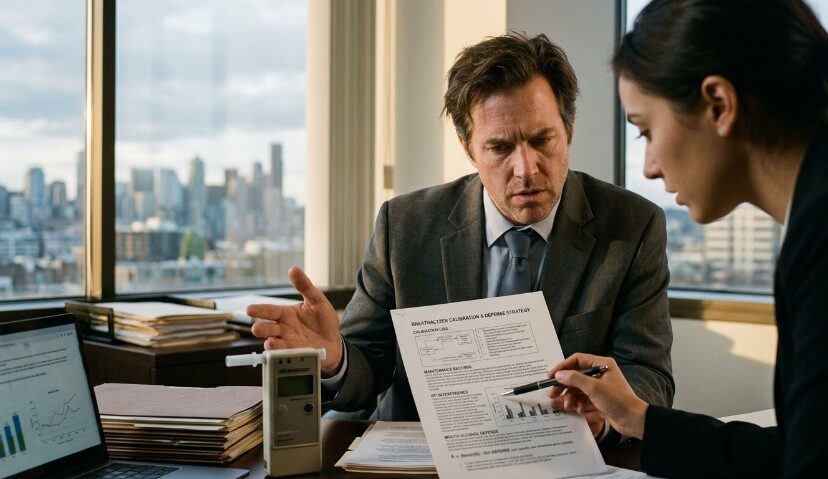
Your defense team should request comprehensive device history, including calibration records, maintenance logs, operator certification files, and quality control documentation. If the prosecution cannot produce evidence that the specific device received recent calibration or that the operator held current certification, the foundation for the breath test crumbles. This discovery process often reveals gaps in the maintenance chain that support motions to suppress or impeach the evidence at trial.
Field Sobriety Test Errors and Probable Cause Challenges
Field sobriety tests (FSTs) frequently serve as the gateway to breath testing. Because preliminary breath tests are used to establish probable cause per NHTSA classifications (NHTSA Countermeasures That Work), errors in administering roadside assessments can taint subsequent breath evidence. If the traffic stop lacked reasonable suspicion or the arrest lacked probable cause due to flawed FST administration, the breath test may be excluded as fruit of the poisonous tree.
Common standardized test errors include improper administration of the Horizontal Gaze Nystagmus test (where officers must position the stimulus correctly and check for resting nystagmus), errors in the Walk-and-Turn test (failing to demonstrate the heel-to-toe stance or counting aloud properly), and mistakes in the One-Leg Stand protocol (not timing the thirty-second duration accurately). These deviations compromise the officer’s stated justification for arrest, potentially rendering the breath evidence inadmissible regardless of the numerical result.
Standardized Field Test Administration Errors
NHTSA protocols require specific conditions for eye tests and divided attention tasks. Officers must check for equal pupil size and resting nystagmus before beginning the HGN test, and they must provide clear instructions and demonstrations for the Walk-and-Turn. When officers rush through these steps, conduct tests on uneven surfaces, or ignore physical disabilities that affect performance, they undermine the validity of the probable cause determination that justifies the arrest and subsequent breath testing.
Challenging the Chain of Evidence
FST failures combined with PBT results create the probable cause narrative that supports your arrest. If your attorney successfully challenges the FST administration—demonstrating that the officer lacked proper training or deviated from standardized protocols—the entire chain of evidence weakens. Without valid probable cause, the breath test results may be suppressed under Fourth Amendment exclusionary rule principles, even if the machine functioned perfectly.
DUI Defense Strategies for Challenging Evidence in Court
Effective DUI defense strategies combine scientific challenges with constitutional arguments. The rising blood alcohol concentration defense leverages the pharmacokinetic reality that alcohol absorption continues after you stop drinking. Your BrAC measured at the station—perhaps forty-five minutes after driving—may significantly exceed your BAC at the time of actual operation, creating reasonable doubt about whether you were legally impaired while behind the wheel. This defense does not rely on specific absorption rates but rather on the established principle that alcohol levels fluctuate during the absorption phase.
Constitutional suppression motions remain powerful tools. If officers delayed obtaining a warrant for a blood draw when one was reasonably available, McNeely provides grounds for exclusion. If officers coerced consent for a blood test without explaining consequences, or if the arrest itself violated Birchfield’s limits, your attorney may file motions to suppress the chemical evidence entirely.
Discovery tactics should include demanding: – CPL verification for the specific device used – Calibration and maintenance logs for the previous year – Operator training certificates and current certification status – Documentation of the observation period – Printed test records with unique identifying numbers
When the device lacks CPL certification or maintenance records show calibration lapses, federal standards become impeachment tools that cast doubt on the prosecution’s technical evidence.
The Rising Blood Alcohol Concentration Defense
Alcohol absorption does not halt when police initiate the traffic stop. If you consumed alcohol shortly before driving, your BAC may have been below the legal limit while operating the vehicle but above it by the time you reached the station. This scientific principle undermines the prosecution’s ability to prove intoxication at the relevant time—when you were actually driving—rather than merely showing you were intoxicated while standing in the booking room.
Discovery and Suppression Tactics
Specific documents to demand include calibration records proving external checks occurred, CPL status verification confirming the device met federal standards, operator certificates demonstrating current training, and observation period notes. Constitutional violations regarding warrantless blood draws or coerced consent trigger exclusion of breath evidence under the Fourth Amendment, effectively removing the prosecution’s primary scientific proof of intoxication.
Case Outcomes When Breathalyzer Results Are Excluded
Successfully excluding breath evidence does not guarantee dismissal, but it fundamentally alters the prosecution’s position. Without BrAC readings, the state loses its per se intoxication claim in many jurisdictions, forcing reliance on impairment theories based on officer observations, FST performance, and dashcam video. Without a BAC number, prosecutors must pivot to proving impairment through circumstantial evidence, such as testimony about erratic driving, the driver’s physical appearance, slurred speech, and poor performance on field sobriety tests.
The nature of your suppression victory affects remaining case strength. Exclusion based on constitutional violations—such as McNeely warrant delays or Birchfield consent issues—often provides stronger leverage for dismissal than technical calibration challenges, though both create negotiation advantages. Constitutional violations undermine the integrity of the entire investigation, whereas calibration issues merely question the device’s accuracy.
Prosecution Options Without Breath Evidence
States frequently pivot to observational impairment cases when BrAC readings disappear. Officers testify about driving patterns, physical indicators like bloodshot eyes or alcohol odor, and performance on standardized field tests. Video evidence from body cameras or patrol cars becomes crucial in these scenarios, as juries must weigh subjective officer testimony against your actual appearance and behavior on film.
Negotiating Resolutions After Suppression
Successful challenges to calibration records or constitutional violations shift bargaining power substantially. When the prosecution faces the prospect of proceeding without scientific evidence or defending against civil liability for Fourth Amendment violations, they become more amenable to reduced charges such as reckless driving or traffic infractions. The specific outcome depends on your jurisdiction’s laws, your prior record, and the strength of remaining evidence, but suppression generally transforms a seemingly hopeless case into a negotiable situation.
If you’re facing charges based on breath test evidence, remember that these devices are fallible instruments operated by humans under stressful conditions. By understanding the federal standards that govern device certification, asserting your constitutional protections against unlawful searches, and scrutinizing the specific circumstances of your test, you can mount a credible defense against the machine’s verdict. The difference between a conviction and a dismissal often lies in the details hidden within calibration logs, observation notes, and Supreme Court precedent. Consult with an attorney who understands both the science of breath testing and the constitutional boundaries of police authority to ensure your rights remain protected throughout the process.