

Trucking Lawsuits: Why Settlements Are Usually Higher in the USA
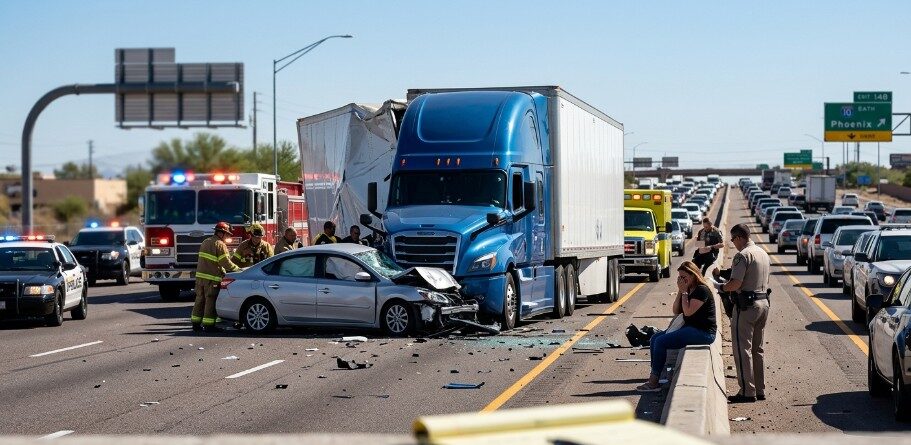
Imagine driving home on the interstate when an 80,000-pound tractor-trailer drifts into your lane. The collision changes everything in an instant. If you or a loved one has suffered serious injuries in a crash like this, you are likely facing mounting medical bills, lost income, and an uncertain future. You have probably heard that truck accident cases often result in larger payouts than typical car crashes, but you may wonder why that is and whether it applies to your situation. This guide explains the specific legal and regulatory factors that drive higher compensation in commercial truck cases, the federal rules that create unique evidence advantages for victims, and why acting quickly to preserve records can make or break your claim.
Why Truck Crash Settlements Exceed Typical Car Accident Payouts
The physics of a truck collision create fundamentally different outcomes than a crash between two passenger vehicles. According to the Insurance Institute for Highway Safety (IIHS), 5,005 people died in large-truck crashes in 2022 (the most recent year for finalized IIHS data), and 65% of those killed were occupants of cars and other passenger vehicles, while only 16% were truck occupants. This disparity reflects the massive weight and size differential between a fully loaded tractor-trailer and a standard automobile.
Loaded tractor-trailers require 20% to 40% more stopping distance than cars, a gap that worsens on wet or slippery roads or when brake maintenance is neglected. The FMCSA Large Truck Crash Causation Study found that brake problems appeared as an associated factor in 29% of the studied trucks, carrying a relative risk figure of 2.7. These mechanical and physical realities translate directly into catastrophic injury patterns that drive up the value of legitimate claims.
When a passenger vehicle bears the brunt of a truck’s momentum, occupants frequently suffer spinal cord damage, traumatic brain injury (TBI), multiple fractures, and internal organ damage. These injuries generate enormous economic damages through lifetime medical care, home modifications, vocational retraining, and lost earning capacity. Higher truck accident settlements reflect the severity of these harms and the long-term care costs they necessitate, not “jackpot” justice. The correlation between injury severity and compensation is direct: when a victim requires millions in future medical support, the settlement must account for those realities or the victim faces financial ruin.
The Federal Regulatory Framework Governing Commercial Motor Vehicles
Trucking lawsuits differ from standard car accident claims because of a comprehensive federal regulatory overlay that does not apply to private passenger vehicles. Under 49 CFR § 390.5T, a Commercial Motor Vehicle (CMV) includes any vehicle used in interstate commerce with a Gross Vehicle Weight Rating (GVWR) or Gross Combination Weight Rating (GCWR) of 10,001 pounds or more. This definition captures most tractor-trailers and many delivery trucks that travel across state lines.
The Federal Motor Carrier Safety Administration (FMCSA) imposes uniform safety standards across the USA that create a federal floor for insurance, driver qualifications, vehicle maintenance, and hours of service. While private drivers need only comply with state traffic laws, commercial carriers must maintain specific levels of financial responsibility, systematically inspect their fleets, and monitor driver compliance with federal health and safety rules. This regulatory framework generates a paper trail of evidence that simply does not exist in ordinary fender-benders.
However, while federal trucking industry regulations provide the tools to prove liability, they do not control the ultimate amount of compensation available. Damages caps, comparative fault rules, statutes of limitations, and the availability of punitive damages remain governed by state law. This dual-layer system means your attorney must understand both the federal safety standards that prove negligence and the state-specific rules that determine how much you can actually recover.
Federal Insurance Minimums and the MCS-90 Endorsement
Federal law mandates significantly higher insurance coverage for commercial trucks than most states require for personal automobiles. Under 49 CFR § 387.9, for-hire interstate carriers hauling nonhazardous freight in vehicles over 10,001 pounds must maintain at least $750,000 in public liability coverage. This minimum increases to $1,000,000 for certain oil and hazardous materials transport, and jumps to $5,000,000 for specified high-hazard cargo including certain bulk hazardous materials and highway-route-controlled quantities of radioactive materials. These federal insurance coverage floors create deeper coverage pools than the $25,000 or $50,000 policies common in passenger vehicle cases.
Beyond these minimums, many carriers purchase excess coverage or umbrella policies worth millions more. When you pursue a commercial truck settlement, you are typically negotiating with insurers who expect high-severity claims and have reserved substantial funds to cover them.
Coverage Tiers by Cargo Classification
The federal minimum liability thresholds break down by cargo risk. General freight carriers face a $750,000 requirement, while those hauling oil and certain hazardous wastes must carry $1,000,000. The $5,000,000 tier applies to the most dangerous cargoes, including explosives, poisonous gases, and large quantities of radioactive materials. These tiers recognize that hazardous materials transport significantly increases the potential scope of damage in a crash, ensuring that victims of chemical spills or fires have access to substantial compensation resources.
The MCS-90 Endorsement Mechanism
Every motor carrier subject to federal regulation must attach Form MCS-90 to their liability policy per 49 CFR § 387.15. This endorsement guarantees payment of public liability judgments even when technical policy defenses might otherwise void coverage. Unlike vehicle-specific endorsements, the MCS-90 attaches to the carrier’s policy as a whole, ensuring that victims can recover against the insurance pool even if the specific truck involved was not properly listed on the declarations page. This mechanism prevents insurers from denying valid truck accident settlements based on clerical errors while ensuring that compensation remains available for catastrophic injury claims.
Vicarious Liability and Multiple Defendants in Trucking Cases
Trucking company liability extends far beyond the individual driver through the legal doctrine of vicarious liability, also known as respondeat superior. When a driver operates within the scope of employment, the carrier becomes responsible for negligent acts committed behind the wheel. This principle ensures that deep-pocketed companies—not just individual drivers—stand behind the safety of their operations.
Carriers also face direct liability for negligent hiring when they fail to screen drivers properly. Under 49 CFR § 391.23, motor carriers must obtain a three-year motor vehicle record history from each state and investigate the driver’s safety performance history with previous DOT-regulated employers before putting them on the road. When companies skip these steps or ignore red flags, they expose themselves to direct negligence claims separate from the driver’s fault.
Employer Liability and Negligent Retention
A carrier’s duty does not end at hiring. Under 49 CFR § 382.301, companies must conduct pre-employment controlled-substances testing, and under 49 CFR § 391.25, they must perform an annual inquiry and review of each driver’s record to monitor their qualifications. If a trucking company retains a driver after failed drug tests, serious traffic violations, or hours-of-service violations, they may face claims for negligent retention. This liability attaches even when the driver appears solely at fault for a crash, because the systemic failure to remove unsafe drivers constitutes independent corporate negligence.
Third-Party Defendants Beyond the Carrier
Modern supply chains introduce multiple potential defendants. Under 49 CFR § 393.100, cargo must be loaded and secured to prevent shifting that adversely affects vehicle stability. When loading companies fail to properly distribute weight or secure freight, they become liable for resulting rollovers or loss-of-control crashes. Independent maintenance vendors who perform inadequate brake repairs under 49 CFR § 396.3 and brokers who negligently select unsafe carriers can also be joined as defendants. Each additional liable party brings separate insurance coverage, increasing total available compensation without diminishing individual liability.
Evidence Advantages: The Regulatory Paper Trail
Federal mandates create an extensive documentary record that strengthens truck accident claims. Electronic Logging Devices (ELDs), required under 49 CFR § 395.3, automatically record driver duty status, capturing whether a driver complied with the 10-hour off-duty requirement, the 14-hour on-duty window, and the 11-hour driving limit. These digital records provide objective, tamper-resistant proof of hours-of-service violations that can establish negligence per se.
Under 49 CFR § 396.3, maintenance records must be retained for one year and for an additional six months after the motor vehicle leaves the motor carrier’s control. These files contain inspection reports, brake repair invoices, and mechanic notes that can reveal systemic neglect. Additionally, 49 CFR § 390.15 requires motor carriers to maintain an accident register for three years, documenting date, location, driver name, injuries, and fatalities for every crash.
Pre-employment drug testing records under 49 CFR § 382.301 and driver qualification files under 49 CFR § 391.23 round out the evidence portfolio. Because these records are federally mandated, courts impose severe spoliation sanctions when carriers destroy them after a crash, making preservation letters a powerful early tool for plaintiffs.
Hours-of-Service Violations and Fatigue Claims
The 10/14/11-hour rules create clear benchmarks for driver fatigue. ELD data provides irrefutable proof when a driver exceeds the 11-hour driving limit or operates after the 14th hour on duty. Critically, 49 CFR § 392.3 prohibits operating a commercial vehicle while fatigued or ill regardless of whether hours technically remain on the clock. This regulation allows victims to pursue claims based on observable impairment even when the logbook appears compliant.
Maintenance Records and Post-Crash Investigations
The one-year/six-month retention rule for maintenance files creates a ticking clock for evidence preservation. Once a vehicle leaves a carrier’s fleet, maintenance records can be destroyed after six months. Immediate preservation letters from a truck accident lawyer ensure that brake inspection reports, tire replacement records, and repair invoices remain available to prove negligent maintenance. Similarly, the three-year accident register requirement ensures that patterns of prior crashes involving the same driver or fleet can be discovered and used to demonstrate systemic safety failures.
Valuing Catastrophic Damages in Multi-Million Dollar Cases
Truck crash settlements distinguish between economic damages—tangible financial losses like medical bills, lost wages, and life-care planning costs—and non-economic damages for pain, suffering, and loss of normal life. Catastrophic injuries common in these collisions, such as spinal cord damage and traumatic brain injury, generate multi-million dollar valuations due to lifetime care requirements. A 25-year-old with a high-level spinal cord injury may face $5 million or more in future medical expenses alone.
Punitive damages may also be available under state law when carriers knowingly violate safety regulations, such as encouraging drivers to falsify logbooks or ignoring maintenance schedules to save money. These damages punish egregious conduct and deter future violations.
Research from the American Transportation Research Institute (ATRI) illustrates the negotiation dynamics in these cases. In sub-$1 million trucking matters, settlements averaged 37.7% larger than verdict awards, suggesting that early fair settlement often exceeds the risk-adjusted value of trial. This data underscores why thorough preparation and documentation of damages often leads to favorable truck accident settlements without the uncertainty of a jury trial.
Working With a Truck Accident Lawyer to Preserve Evidence
Immediate action determines the strength of your case. Within days of a crash, you need a lawyer to issue litigation holds preventing the destruction of ELD data, driver qualification files, and maintenance logs, especially given the six-month disposal window for records of vehicles that have left the carrier’s service. Trucking insurers aggressively defend claims because they face high policy limits and regulatory exposure; they often deploy rapid response teams to the scene within hours to protect their interests.
Your attorney must navigate the intersection of federal and state law. While FMCSA regulations provide the evidence to prove liability, state statutes of limitations control how long you have to file, and state damage caps or comparative fault rules determine your ultimate recovery. Counsel familiar with both systems can secure the federal records you need while ensuring compliance with state-specific procedural requirements. Do not wait until the six-month maintenance record disposal period expires to seek legal help.
Key Takeaways for Trucking Accident Victims
Four pillars support high-value commercial truck claims. First, catastrophic injury severity creates legitimate damages in the millions of dollars. Second, elevated federal insurance minimums ranging from $750,000 to $5,000,000 provide substantial coverage pools. Third, vicarious liability and direct negligence theories allow you to pursue multiple defendants—including carriers, loaders, and maintenance vendors—each with separate insurance towers. Fourth, mandatory federal records like ELD data and maintenance logs provide objective proof of negligence that rarely exists in ordinary car cases.
Remember that while federal trucking industry regulations supply the framework for proving liability, state law controls the amount of compensation available and whether punitive damages apply. If you have suffered serious injuries in a truck crash, consult a qualified attorney immediately to secure electronic logs and maintenance records before statutory disposal periods expire.
You deserve compensation that accounts for the full scope of your injuries and future needs. By understanding the federal safety standards that govern commercial carriers and acting quickly to preserve critical evidence, you position yourself to recover the resources necessary for lifelong care and financial security. Contact an experienced truck accident lawyer today to protect your rights and begin building your case.